Every Authenticated Zodiac Letter and Cipher Explained from 1969 to 1974
The Zodiac Correspondence at a Glance: Between 1969 and 1974, an unidentified serial killer sent over 20 authenticated letters to Bay Area newspapers and police. These communications included four complex cryptograms (ciphers). As of 2026, two of these ciphers (the Z408 and Z340) have been successfully decoded, while two shorter codes (the Z13 and Z32) remain mathematically unsolved. The letters are widely regarded as one of the most infamous examples of a killer using the media to cultivate a public persona.
In the late 1960s and early 1970s, the San Francisco Bay Area was paralyzed by a series of brutal, seemingly random attacks. But what elevated these crimes from local tragedies to an international historical phenomenon was the killer's relentless desire for publicity. Through a series of handwritten and typed communications—collectively known as the Zodiac letters—the perpetrator taunted police, threatened the public, and demanded front-page attention.
Understanding the Zodiac letter archive requires looking beyond the sensationalism. These documents are a mix of psychological manipulation, complex cryptography, and shifting personas. This comprehensive breakdown examines the timeline, the cryptographic methods used to crack the codes, and the mathematical reasons why some messages may never be read.
What Did the Zodiac Killer Say in His First Letters?
The correspondence officially began on July 31, 1969. On this day, three nearly identical letters arrived at the offices of the San Francisco Chronicle, the San Francisco Examiner, and the Vallejo Times-Herald. This coordinated mailing established the killer's primary method of operation: using the press as a megaphone.
The letters were notable for several distinct characteristics that would become the killer's trademarks. First, they introduced the infamous "incipit"—the opening line that would chill readers for years: "This is the Zodiac speaking." Second, the letters were signed with a crosshair symbol (a circle with a cross through it), which has since been theorized to represent everything from a gun sight to a watch brand logo to an occult symbol.
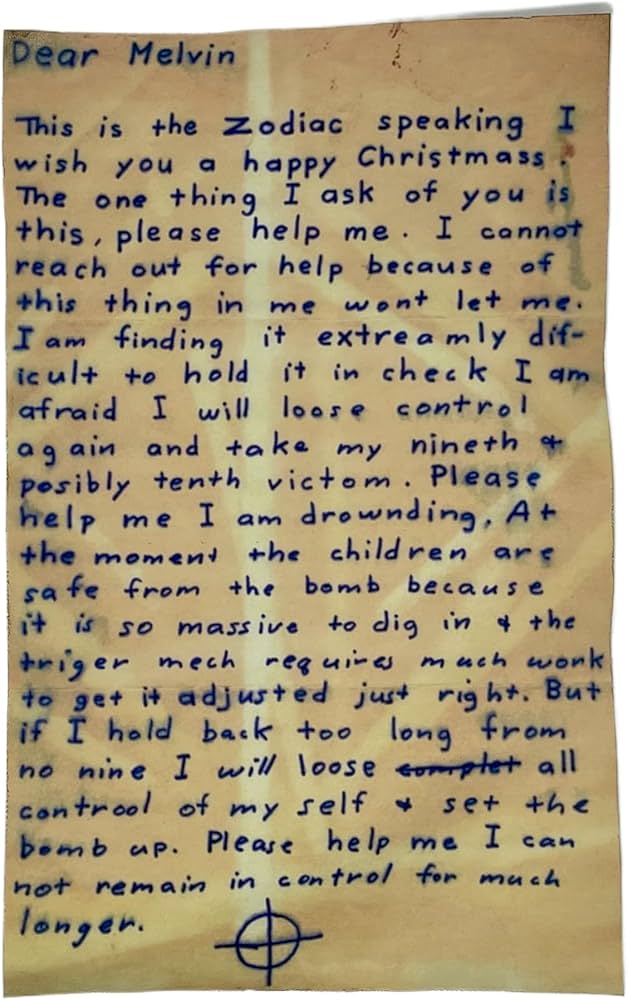
Image source: Amazon.com
To ensure the police and the public knew these were not the ramblings of a crank, the author provided specific, non-public details about two recent attacks: the December 1968 murders of David Faraday and Betty Lou Jensen, and the July 1969 murder of Darlene Ferrin (and the attempted murder of Michael Mageau). The letters detailed the brand of ammunition used (Super X), the number of shots fired, and the exact positioning of the victims' bodies.
Accompanying these threats was the first of the killer's cryptograms. The cipher was split into three parts, with one section sent to each of the three newspapers. The demand was clear: publish the codes on the front page, or a weekend killing spree would commence. The newspapers complied, publishing the ciphers and inadvertently launching one of the most intense amateur code-breaking efforts in American history.
How the Infamous Z408 Cipher Was Cracked in Days
The first cipher, known as the Z408 (named for its 408 characters), did not stump the authorities for long. While the FBI and naval intelligence were analyzing the code, an amateur couple from Salinas, California—Donald and Bettye Harden—managed to crack it over a single weekend in August 1969.
The Z408 was a homophonic substitution cipher. In a simple substitution cipher, one letter is replaced by one symbol (e.g., A = %, B = #). However, because the letter "E" appears so frequently in the English language, simple substitution is easily broken using frequency analysis. A homophonic substitution cipher attempts to mask this by assigning multiple different symbols to high-frequency letters. For example, the letter "E" might be represented by seven different symbols, flattening the frequency curve and making the code harder to break.
To break the Z408, Bettye Harden utilized a cryptographic concept known as a "crib." A crib is a word or phrase that the codebreaker strongly suspects will appear in the plaintext. Given the killer's massive ego and the nature of the crimes, Bettye guessed that the cipher would begin with the word "I" and would prominently feature the word "KILL." By mapping these assumed letters to the repeating symbols, the Hardens unraveled the entire structure.
The decoded message revealed a disturbing glimpse into the killer's mindset, beginning with the chilling phrase: "I like killing people because it is so much fun." The text went on to claim that the victims would become the killer's "slaves" in the afterlife, a concept seemingly borrowed from a distorted interpretation of various mythologies or pulp fiction.
However, the Z408 solution left a lingering mystery. The final 18 characters of the cipher decoded to a seemingly nonsensical string of letters: EBEORIETEMETHHPITI. For decades, researchers and amateur sleuths have debated the meaning of this string. Some argue it is a complex anagram containing the killer's true name (which would require testing billions of transpositions). Others, including many professional cryptographers, believe it is simply "filler"—random letters added to complete the rectangular grid of the cipher block.
Why the Z340 Cipher Took 51 Years to Solve
Following the rapid defeat of his first code, the Zodiac Killer escalated his cryptographic efforts. On November 8, 1969, he mailed the "Dripping Pen" card to the San Francisco Chronicle, accompanied by a new, 340-character cryptogram. This code, the Z340, would frustrate law enforcement, military intelligence, and supercomputers for more than half a century.
The Z340 was finally cracked in December 2020 by an international three-person team: American software developer David Oranchak, Australian applied mathematician Sam Blake, and Belgian programmer Jarl Van Eycke. The FBI officially confirmed the solution shortly after the team presented their findings.
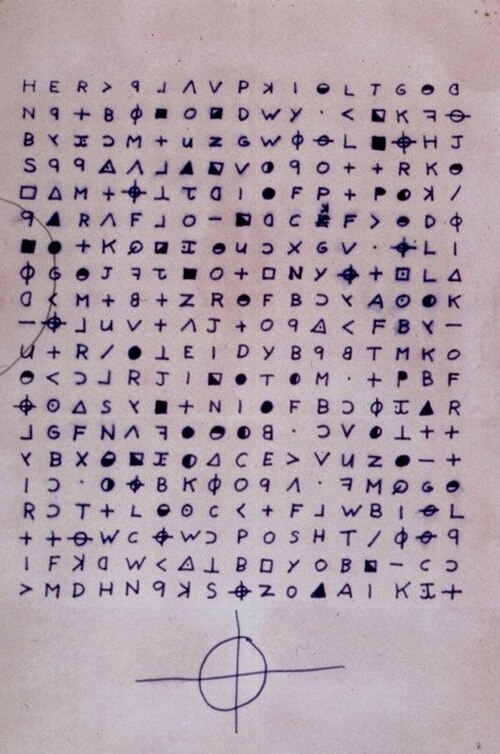
Image source: upload.wikimedia.org
The reason the Z340 remained unsolved for 51 years is that it was not merely a substitution cipher like the Z408; it also utilized a complex transposition step. The killer did not write the message straight across the page from left to right. Instead, he used a directional pattern.
The 1,2-Decimation Breakthrough
The breakthrough came when the team discovered the killer used a "1,2-decimation" pattern—often compared to the movement of a Knight in chess. To read the message, one had to start at the top-left character, move down one row, and then shift right by two columns to find the next character. This diagonal, wrapping pattern scrambled the text completely.
Furthermore, the killer split the 340-character grid into three distinct horizontal blocks: a 9-line section, another 9-line section, and a final 2-line section. The transposition pattern had to be applied to each block individually. The team utilized custom software called AZdecrypt (developed by Van Eycke) and advanced computational tools like Mathematica to run through over 155 trillion possible reading directions before finding the correct alignment.
The resulting plaintext read, in part: "I hope you are having lots of fun in trying to catch me... I am not afraid of the gas chamber because it will send me to paradice all the sooner." (The spelling errors, such as "paradice," were consistent with the killer's other writings).
Comparing the Four Primary Zodiac Ciphers
To understand the scale of the killer's cryptographic campaign, it is helpful to view the four primary ciphers side-by-side. The table below outlines their lengths, encryption types, and current status.
| Cipher Name | Date Sent | Length | Encryption Method | Current Status |
|---|---|---|---|---|
| Z408 | July 31, 1969 | 408 chars | Homophonic Substitution | Solved (1969) |
| Z340 | Nov 8, 1969 | 340 chars | Substitution + Transposition | Solved (2020) |
| Z13 | April 20, 1970 | 13 chars | Unknown | Unsolved |
| Z32 | June 26, 1970 | 32 chars | Map-based / Unknown | Unsolved |
What Are the Unsolved Zodiac Ciphers Still Hiding?
While the Z408 and Z340 have been decoded, the Z13 and Z32 remain a lasting mystery. The Z13, mailed on April 20, 1970, is particularly infamous because it is preceded by the tantalizing phrase: "My name is —" followed by 13 symbols. The Z32, sent in June 1970, was accompanied by a map of Mount Diablo and a clue regarding "inches per radians," allegedly pointing to the location of a buried bomb.
A common question among modern true crime enthusiasts is: Why can't artificial intelligence or modern supercomputers crack these short codes?
The answer lies in a mathematical concept formulated by Claude Shannon known as Uniqueness Distance. Uniqueness distance is the minimum amount of ciphertext required to break a cipher and arrive at a single, unambiguous solution. If a cipher is shorter than its uniqueness distance, there is not enough data to prove that any given solution is the correct one.
Because the Z13 is only 13 characters long, it falls far below the uniqueness distance for a homophonic substitution cipher. As cryptography experts note, you can mathematically map thousands of grammatically correct English phrases to the Z13's symbol pattern. A researcher could decode it to read "I am Alfred E Neuman," "He is a serial killer," or "My name is Arthur Leigh." Without a longer text sample to verify the symbol assignments, it is mathematically impossible to declare any single solution as the definitive truth. Unless a physical key is found, the Z13 and Z32 are widely considered unsolvable by brute force alone.
How the Zodiac Letters Changed Over Five Years
Reading the Zodiac letters in chronological order reveals a fascinating shift in the author's psychological state and public persona. The communications can be broadly categorized into three distinct phases.
The Violent Phase (1969–1970)
The early letters were characterized by direct, brutal threats and a need to prove authenticity. Following the murder of taxi driver Paul Stine in October 1969, the killer mailed a letter containing a blood-soaked swatch of Stine's shirt. This grisly inclusion was an undeniable proof of identity, silencing any doubts that the letter writer and the killer were the same person. During this phase, the letters frequently threatened school buses and detailed bomb schematics.
The Taunting Phase (1970–1971)
As the immediate murders seemingly ceased, the letters shifted toward grandiosity and taunting. The killer began keeping a "score" at the bottom of his letters (e.g., "SFPD = 0, Zodiac = 13"). He referenced the Gilbert and Sullivan comic opera The Mikado, quoting lyrics about a "little list" of society offenders who would not be missed. The tone became increasingly theatrical.
The Cultural Phase (1974)
After a nearly three-year silence, the Zodiac sent a final cluster of letters in 1974. By this point, the persona had evolved into that of a bizarre cultural critic. The "Exorcist" letter, mailed in January 1974, offered a review of the horror film The Exorcist, calling it "the best saterical comidy that I have ever seen." Another letter praised the film Badlands. The violent threats were replaced by complaints about newspaper columnists (like Count Marco) and demands for specific font choices in the newspaper. The killer's final authenticated tally claimed 37 victims, though law enforcement has only ever confirmed five deaths and two survivors.
How to Tell a Real Zodiac Letter from a Hoax
Because the Zodiac Killer achieved such massive notoriety, his correspondence spawned dozens of copycats and hoaxes. Law enforcement and archival researchers categorize the letters into strict authentication tiers. Authenticated letters are those verified by handwriting analysis, historical context, and, in some cases, physical evidence (like the Stine shirt swatches).
However, several communications remain hotly debated within the investigative community:
- The Riverside Connection: In 1966, student Cheri Jo Bates was murdered in Riverside, California. Anonymous typewritten letters were sent to the police and her father, claiming responsibility. While the Zodiac later claimed credit for the Bates murder, many investigators believe the Riverside letters were written by a different individual, and the Zodiac merely co-opted the crime to inflate his victim count.
- The Secret Pal Card: Sent in 1970, this greeting card is often linked to the Zodiac, but its authenticity is debated. It lacks the definitive crosshair signature and handwriting matches of the primary letters.
- The 1978 Letter: A letter sent in 1978 claiming to be the Zodiac was initially authenticated but later suspected to be a forgery, leading to a massive scandal involving SFPD Inspector Dave Toschi (though Toschi was later cleared of writing it).
Modern efforts to authenticate the letters rely heavily on DNA analysis. Investigators have attempted to extract "touch DNA" from the saliva used to seal the envelopes and affix the stamps. However, the degradation of the evidence over 50 years, combined with the fact that the letters were handled by dozens of police officers and reporters before modern forensic protocols were established, has made extracting a clean, definitive DNA profile exceptionally difficult.
Frequently Asked Questions
How many letters did the Zodiac Killer actually send?
What was the last letter the Zodiac ever sent?
Did the Zodiac ever reveal his real name in a letter?
What does the crosshair symbol mean?
Where are the original Zodiac letters kept today?
Final Takeaways on the Zodiac Correspondence
The Zodiac letters represent a unique intersection of true crime, media manipulation, and cryptography. While the physical trail of the killer went cold decades ago, the archival documents continue to be studied by cryptographers and historians alike. Here are the core facts to remember about the correspondence:
- The Timeline: The authenticated communications span a five-year period, beginning with the triple-mailing on July 31, 1969, and concluding with a series of cultural critiques in 1974.
- The Cryptographic Success: Two of the four ciphers have been solved. The Z408 was cracked in 1969 using homophonic substitution analysis, and the Z340 was decoded in 2020 using a complex 1,2-decimation transposition method.
- The Mathematical Limit: The remaining Z13 and Z32 ciphers are widely regarded as unsolvable due to their short length, which falls below the "uniqueness distance" required to prove a definitive mathematical solution.
- The Physical Proof: The killer authenticated his letters not just with hidden knowledge, but with physical evidence, most notably mailing pieces of victim Paul Stine's bloodied shirt.
- The Victim Discrepancy: While law enforcement has officially linked the killer to five murders and two surviving victims, the final 1974 letters claimed a total of 37 victims.
For those interested in the technical side of the case, studying the open-source AZdecrypt software provides an excellent practical introduction to how modern computational methods approach historical transposition ciphers.