How Internal and External Conflict Drive Every Great Story
External conflict is a struggle between a character and an outside force, such as another person, society, or nature. It drives the physical plot and creates the "what happens next." Internal conflict is a psychological struggle within a character's mind, often involving a choice between two desires or a battle against a personal fear. It drives the character arc and emotional growth. A compelling story typically uses both to create a "Conflict Cycle" where outside events trigger inside dilemmas.
What Is the Difference Between Internal and External Conflict?
At its most fundamental level, conflict is the engine of narrative. Without it, a story is merely a series of events without stakes. To understand the mechanics of storytelling, we must distinguish between the forces acting upon a character and the forces acting within them. According to StudioBinder, conflict energizes a story by creating tension that demands resolution.
The "Inside vs. Outside" Framework
Internal conflict is a psychological or emotional struggle. It takes place in the heart and mind of the protagonist. This might involve a moral dilemma, a lack of self-belief, or a clash between what a character wants and what they believe is right. Conversely, external conflict involves a character struggling against forces in the world around them. These are tangible obstacles that prevent the character from reaching a physical goal.
The Pacing Analogy: Accelerator vs. Brakes
One helpful way to view these forces is through the "Accelerator vs. Brakes" concept. External conflict often acts as the accelerator; it pushes the plot forward, forcing characters to move, react, and take risks. Internal conflict acts as the brakes, slowing the story down to allow for introspection, doubt, and emotional weight. A story with only an accelerator feels hollow and frantic, while a story with only brakes feels stagnant and overly philosophical.
| Feature | Internal Conflict | External Conflict |
|---|---|---|
| Location | Inside the character's mind/heart | Outside the character's body |
| Primary Goal | Emotional growth or self-discovery | Achieving a physical objective |
| Common Obstacle | Fear, guilt, or past trauma | Antagonists, nature, or laws |
| Story Impact | Drives the character arc | Drives the plot progression |
6 Common Types of External Conflict You Should Know
External conflict is often categorized by the nature of the opposing force. These categories help writers identify the specific pressures being applied to their characters. Many stories rank among the top of their genres by layering multiple types of external conflict simultaneously.
1. Person vs. Person
This is the most recognizable form of conflict. It involves a direct struggle between two characters with opposing goals. This isn't always a hero vs. villain dynamic; it can be two people who simply want the same thing, such as two athletes competing for a single gold medal. The tension arises from the interpersonal friction and the specific tactics each character uses to outmaneuver the other.
2. Person vs. Society
In this scenario, the protagonist stands at odds with social norms, government systems, or cultural expectations. This is a staple of dystopian fiction, where a character might fight against an oppressive regime. It also appears in historical dramas where a character challenges the prejudices of their time. The conflict is often systemic, making the stakes feel much larger than a personal feud.
3. Person vs. Nature
This type of conflict pits a character against the raw power of the natural world. Whether it is a blizzard, a predatory animal, or a vast desert, the environment itself is the antagonist. These stories often focus on survival and the limits of human endurance. A notable example is the film The Revenant, where the protagonist must survive both the elements and the wilderness.
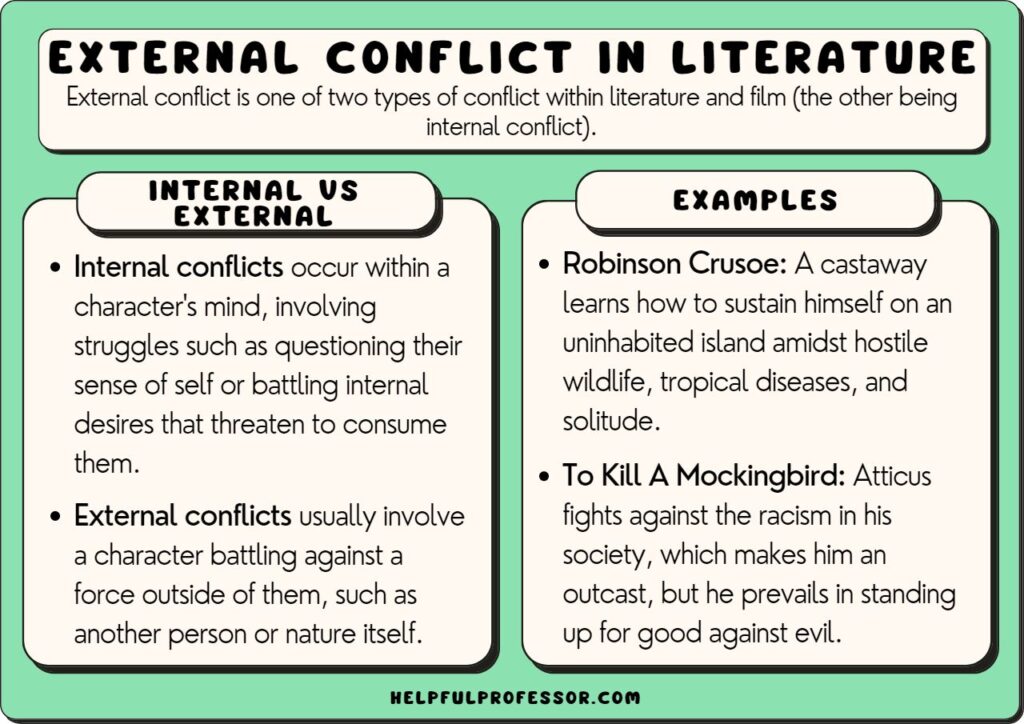
Image source: Helpful Professor
4. Person vs. Technology
As science advances, this conflict becomes increasingly relevant. It involves characters struggling against artificial intelligence, machines, or scientific breakthroughs that have gone awry. This type of conflict often explores themes of humanity, control, and the unintended consequences of innovation. Classic examples include the Terminator franchise or stories involving rogue AI.
5. Person vs. Supernatural
This category covers battles against forces that defy scientific explanation. This includes ghosts, demons, gods, or monsters. In these stories, the character often lacks the traditional tools to fight back, requiring them to find unique or spiritual solutions to their problems. The conflict is often used to explore the unknown or the "other."
6. Person vs. Fate
Rooted in ancient Greek tragedy, this conflict involves a character attempting to break away from a predetermined destiny. No matter how hard they try to change their path, the universe seems to conspire to keep them on it. This creates a unique sense of dread and inevitability, as the character is essentially fighting the laws of their own reality.
Understanding Internal Conflict Through the Man vs. Self Model
While external conflict provides the spectacle, internal conflict provides the soul. It is the reason we care about whether the protagonist succeeds. According to Scribophile Academy, internal conflict is often a tension between two internal forces: Want vs. Fear, or Duty vs. Desire.
The "Thorn" Theory
A significant advancement in character development is the "Thorn Theory." This concept suggests that every character has a "core wound" or past trauma that influences every decision they make. This thorn is the source of their internal conflict. For example, a character who was abandoned as a child might have an internal conflict between their desire for love and their fear of being vulnerable. Every time an external event requires them to trust someone, the "thorn" causes them to hesitate or push people away.
Common Internal Struggles
- Moral Ambiguity: The struggle of doing the wrong thing for the right reason (e.g., stealing to feed a family).
- Imposter Syndrome: A character who has achieved success but internally believes they are a fraud and do not deserve their position.
- Religious or Philosophical Doubt: A character questioning the very foundations of their belief system when faced with a harsh reality.
- Identity Crisis: The tension between who a character is and who they are expected to be by their family or peers.
Famous Examples of Internal and External Conflict in Literature
Literature provides some of the most nuanced examples of how these conflicts interact. By examining classic works, we can see how authors use internal struggles to elevate external plots.
Hamlet by William Shakespeare
In Hamlet, the external conflict is a classic Person vs. Person struggle: Hamlet seeks revenge against his uncle, Claudius, who murdered Hamlet's father. However, the play is widely considered one of the best examples of internal conflict because of Hamlet's crippling indecision. His "Man vs. Self" struggle involves moral questioning and existential dread, famously captured in his "To be, or not to be" soliloquy. The external plot cannot move forward until Hamlet resolves his internal paralysis.
The Great Gatsby by F. Scott Fitzgerald
Jay Gatsby faces a Person vs. Society conflict as he attempts to win over Daisy Buchanan and fit into the "old money" elite of East Egg. However, his true struggle is internal. Gatsby is obsessed with a past that no longer exists, believing he can recreate a moment in time through sheer will and wealth. His internal conflict is the refusal to accept the passage of time, which ultimately leads to his downfall.
Harry Potter by J.K. Rowling
The external conflict is the epic battle against Voldemort (Person vs. Person). Yet, Harry’s internal journey is equally vital. He struggles with the fear of his own potential for darkness—given his connection to Voldemort—and the heavy burden of being the "Chosen One." His growth comes from choosing love and sacrifice over the power and fear that define his antagonist.
Popular Examples of Conflict in Movies and TV
Visual storytelling often uses external conflict to manifest internal struggles. This makes the character's inner world visible to the audience through their actions and reactions.
The Dark Knight
The Joker is a top-tier example of an external force specifically designed to trigger a protagonist's internal crisis. He doesn't just want to kill Batman; he wants to force Batman to break his one rule: not to kill. The external chaos in Gotham is a direct challenge to Batman's internal moral code. This interaction makes the film a significant advancement in the superhero genre.
Inside Out
This film presents a unique case where the internal conflict *is* the external plot. The characters are the emotions inside a young girl's head. The external journey they take through her mind represents her internal struggle to process sadness and change. It is a literal representation of the "Man vs. Self" model, showing how different parts of our identity can be at odds.
Breaking Bad
Walter White begins with a clear external conflict: he has terminal cancer and needs money for his family. However, as the series progresses, the conflict shifts inward. His descent into the persona of "Heisenberg" is driven by his internal need for power and validation after years of feeling overlooked. The external dangers he faces are often consequences of his internal ego and pride.
Real-World Examples of Conflict in the Workplace and Daily Life
Conflict is not limited to fiction; it is a constant presence in our daily lives. Understanding these dynamics can help in professional development and personal relationships.
The Career Advancement Dilemma
In a professional setting, you might face an external conflict where you are competing for a single promotion against a close friend. This creates an immediate internal conflict: the guilt of succeeding at a friend's expense versus the desire for professional validation and financial security. Resolving this requires balancing personal values with career ambitions.
The Health and Wellness Struggle
Consider the goal of training for a marathon. The external conflict involves the physical demands of the training, the weather, and the time commitment. The internal conflict is the psychological urge to seek comfort in old habits versus the new identity of being a "healthy person." This is a classic example of the "Want vs. Fear" dynamic playing out in real-time.
Social and Family Dynamics
Setting boundaries with overbearing family members is a common external conflict. The internal struggle often involves the fear of abandonment or the guilt of "disobeying" parents versus the adult need for autonomy. These real-world scenarios mirror the "Person vs. Society" (or Person vs. Tradition) conflicts found in literature.
How to Intertwine Internal and External Conflict for Better Writing
The most engaging stories do not treat these conflicts as isolated concepts. Instead, they use the "Conflict Cycle" to feed one into the other. This creates a narrative that feels both exciting and deeply meaningful.
An outside event forces the character to act. This could be a sudden job loss, a mysterious letter, or a natural disaster. This sets the plot in motion.
The character’s "Thorn" or internal fear makes them hesitate or make a mistake. Because of their inner struggle, they don't take the most logical path, creating more tension.
The character’s mistake or hesitation creates a new, bigger external problem. The stakes are raised because the character failed to resolve the initial issue.
The character must grow internally to solve the external obstacle. The physical victory is only possible once the emotional victory has been achieved.
Avoiding the "Portrait vs. Story" Trap
Writers must be careful not to lean too heavily on one side. A story with only internal conflict is often called a "Portrait"—it is psychologically deep but lacks urgency; the character essentially sits in a room thinking. Conversely, a story with only external conflict falls into the "Action Movie Trap"—it is full of explosions and chases, but the audience doesn't care if the character succeeds because there is no emotional connection. The best stories stand out as a top choice by balancing both.
Key Takeaways for Mastering Conflict
- Internal conflict is the "Why" behind a character's actions, while external conflict is the "What" that happens in the physical world.
- The Conflict Cycle ensures that every external obstacle tests a character's internal "Thorn" or core wound.
- Person vs. Self is the only internal conflict type, but it is often the most critical for creating a satisfying character arc.
- External conflict types include Person vs. Person, Society, Nature, Technology, Supernatural, and Fate.
- Balance is essential; too much external conflict feels hollow, while too much internal conflict feels stagnant.
- Real-world scenarios like workplace competition or health goals follow the same conflict patterns as fictional narratives.
To improve your own storytelling, try mapping out your protagonist's internal fear and ensuring it directly interferes with their ability to solve the story's main external problem.
Frequently Asked Questions
While experimental fiction or character studies sometimes focus almost exclusively on internal thoughts, most engaging stories require an external catalyst. Without an outside force pushing the character to act, the story risks becoming a "portrait" rather than a narrative. External conflict provides the necessary pressure that forces internal growth to happen.
Person vs. Person is widely considered the most frequent type of external conflict. It is the foundation of most dramas, thrillers, and action stories. However, in modern dystopian and speculative fiction, Person vs. Society has become a dominant force, reflecting contemporary concerns about systemic issues and governance.
A strong internal conflict should feel like an anchor holding the character back from their goal. Use the "Thorn" test: identify a past trauma or deep-seated belief that makes the character's external journey harder. If the character could easily solve the plot without changing who they are, the internal conflict likely needs more depth.
They are related but distinct. Man vs. Supernatural involves a struggle against sentient or active forces like ghosts or gods. Man vs. Fate is a struggle against the concept of destiny itself—the idea that the outcome is already decided by the universe, regardless of the character's choices. Fate is often an invisible, impersonal force.
Internal conflict is typically resolved through a "moment of truth." This is a climactic scene where the character is forced to choose between their old fear (the Thorn) and their new growth. By choosing the path of growth, they overcome their internal struggle, which usually gives them the strength to finally resolve the external conflict.