How the Zodiac Ciphers Were Cracked and Why Some Remain Unsolved
Between 1969 and 1970, the unidentified serial killer known as the Zodiac sent four complex cryptograms to Bay Area newspapers. As of 2026, two have been successfully decoded, while two remain mathematically unproven.
- Z408: Solved in 1969 by amateur cryptographers. Revealed the killer's motive.
- Z340: Solved in 2020 by an international team using advanced heuristic software.
- Z13 & Z32: Remain unsolved. Cryptologists widely agree they are too short to yield a statistically verifiable solution.
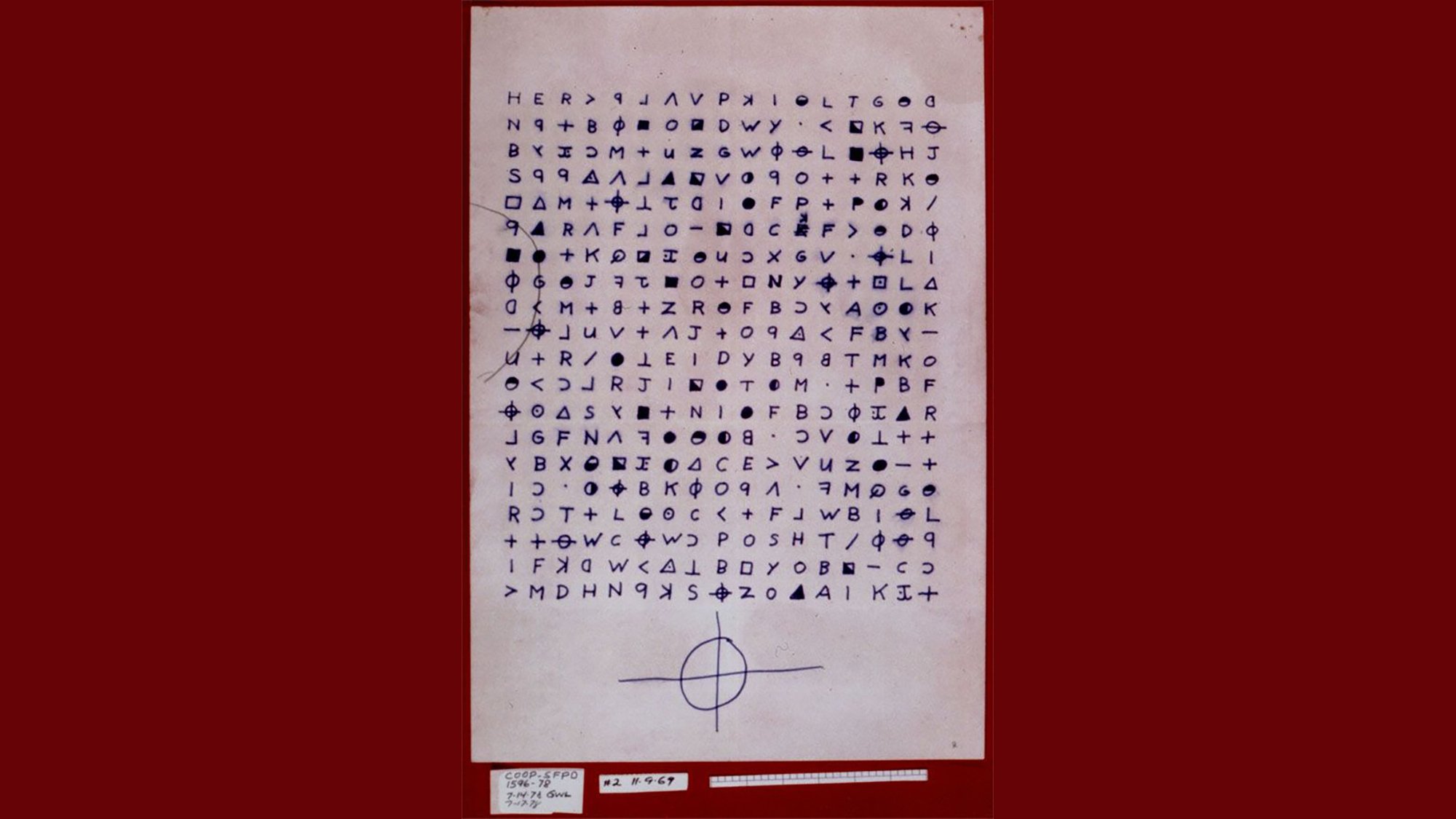
Image source: Popular Science
The Four Cryptograms That Terrified Northern California
In the late 1960s, the San Francisco Bay Area was gripped by fear as an unidentified assailant, who dubbed himself the "Zodiac," began a string of seemingly random murders. While law enforcement has confirmed five victims who died in the attacks (and two who survived), the killer's own letters claimed responsibility for 37 deaths.
What set the Zodiac apart from other criminals of the era was his relentless communication with the press. He demanded his letters be published on the front pages of major newspapers, threatening further violence if his demands were ignored. Accompanying several of these letters were complex cryptograms—grids of symbols that he claimed contained his identity, his motives, and the locations of hidden explosives.
Over the course of his active communication period, the killer sent four distinct ciphers, named by cryptologists based on their character counts:
| Cipher Name | Date Sent | Length | Current Status |
|---|---|---|---|
| Z408 | July 31, 1969 | 408 characters | Solved (1969) |
| Z340 | November 8, 1969 | 340 characters | Solved (2020) |
| Z13 | April 20, 1970 | 13 characters | Unsolved |
| Z32 | June 26, 1970 | 32 characters | Unsolved |
The study of these four texts has evolved from manual frequency analysis in the 1960s to the application of advanced supercomputing in the 21st century. Understanding how the solved ciphers were broken provides crucial context for why the remaining two continue to baffle experts.
What Did the First Zodiac Cipher Say?
On July 31, 1969, the Zodiac sent a cipher divided into three parts to three different newspapers: the San Francisco Chronicle, the San Francisco Examiner, and the Vallejo Times-Herald. This 408-character message, known as the Z408, was the killer's introduction to the world.
Despite the FBI and naval intelligence agencies working on the code, it was cracked in roughly one week by a Salinas, California schoolteacher named Donald Harden and his wife, Bettye. Their approach was a masterclass in logical deduction and psychological profiling.
The Hardens recognized that the cipher was a homophonic substitution cipher. In a simple substitution cipher, one symbol always equals one letter (e.g., A = %, B = #). However, in a homophonic substitution, common letters like 'E' or 'T' are assigned multiple different symbols to flatten the statistical frequency of the characters, making it harder to crack.
Bettye Harden theorized that a killer seeking attention would likely begin his message with the word "I". Furthermore, they looked for double-letter patterns. Assuming the killer was writing about his crimes, they searched for the pattern of the word "KILL" (a four-letter word with a double letter at the end). By aligning these assumptions with the symbol frequencies, the cipher unraveled.
The successful decryption of the Z408 gave the public a false sense of confidence. When the next cipher arrived a few months later, many assumed it would be broken just as quickly. They were wrong.
How an International Team Finally Cracked the Z340 Cipher
On November 8, 1969, the Zodiac mailed a greeting card containing a new 340-character cryptogram. For 51 years, the Z340 stood as a highly complex puzzle, resisting the efforts of the FBI, the NSA, and thousands of amateur cryptographers.
The breakthrough finally came in December 2020. An international team comprising American software developer David Oranchak, Australian applied mathematician Sam Blake, and Belgian warehouse operator and programmer Jarl Van Eycke successfully decoded the message. The FBI officially confirmed the solution shortly after.
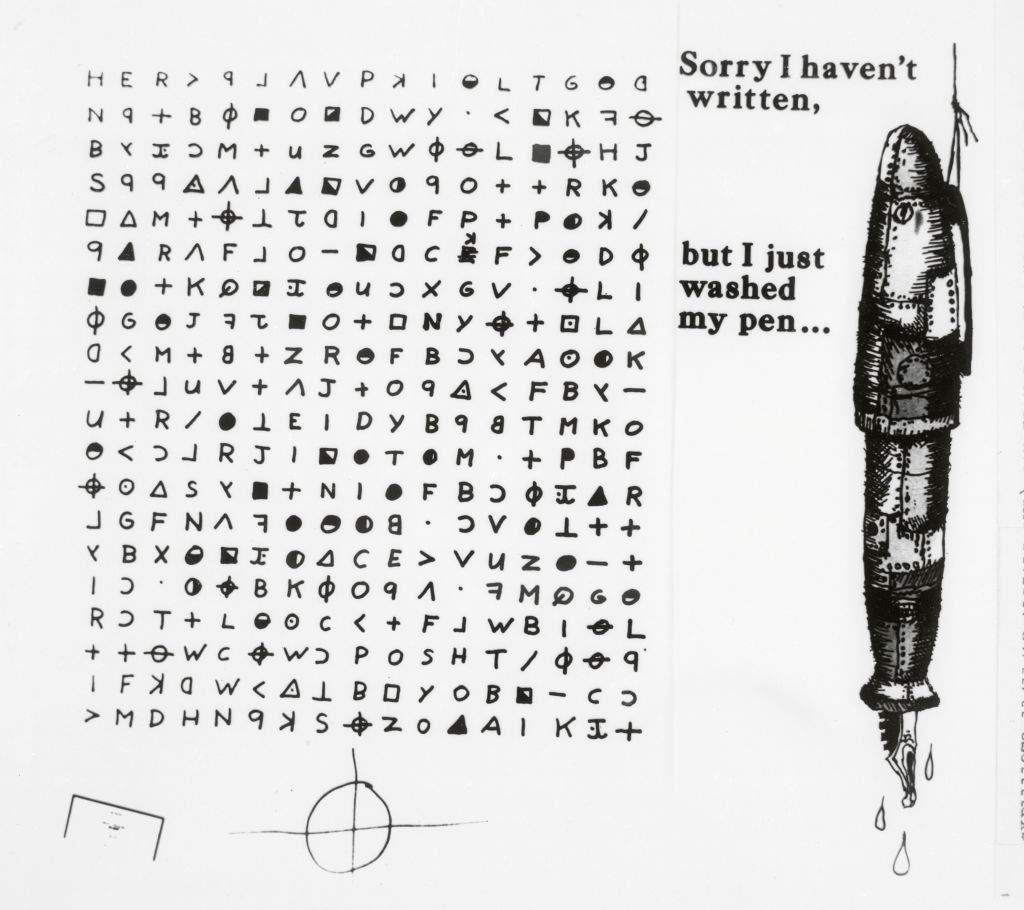
Image source: Global News
The team's success was not the result of a sudden "eureka" moment, but rather years of methodical testing. Oranchak had been running a YouTube series detailing his attempts to crack the code, while Van Eycke had developed a highly specialized decryption program called AZdecrypt. Blake contributed by generating hundreds of thousands of potential reading directions for the cipher grid.
The decoded message read, in part: "I hope you are having lots of fun in trying to catch me... I am not afraid of the gas chamber because it will send me to paradice all the sooner." (The misspelling of "paradise" was consistent with the killer's other letters).
The Diagonal Transposition Trick That Fooled the FBI for Decades
Why did the Z340 take 51 years to solve when the Z408 took only a week? The answer lies in a cryptographic technique known as transposition.
The Z408 was read normally: left to right, top to bottom. The FBI and amateur sleuths assumed the Z340 followed the same rule. However, the Zodiac had added a layer of complexity. Before applying his homophonic substitution, he rearranged the letters of his message using a specific geometric pattern.
To read the Z340 correctly, one must start at the top-left corner, then move down one row and over two columns to find the next letter. This diagonal movement is similar to how a knight moves on a chessboard, albeit stretched out. When the reader reaches the right edge of the grid, they wrap around to the left side.
Furthermore, the killer did not apply this rule to the entire block of text uniformly. He split the 340-character grid into three distinct sections:
- A top block of 9 lines
- A middle block of 9 lines
- A bottom block of 2 lines
Because the letters were scrambled diagonally across these blocks, traditional frequency analysis tools—which look for adjacent letter pairings like "TH" or "ER"—were completely useless. The letters that formed those pairs were separated by multiple rows and columns. It wasn't until Sam Blake generated over 650,000 different transposition variations and fed them into Van Eycke's AZdecrypt software that the "Down 1, Over 2" pattern finally yielded readable English.
Why the Z340 Referenced a 1969 Television Broadcast
Beyond its cryptographic mechanics, the Z340 solution provided significant historical context. The opening line of the decoded message states: "That wasn't me on the TV show."
This specific phrasing is a direct reference to an event that occurred on October 22, 1969. On that day, a person claiming to be the Zodiac Killer called into The Jim Dunbar Show, a live television program broadcast on KGO-TV in San Francisco. The caller, who referred to himself as "Sam," spoke with host Jim Dunbar and prominent defense attorney Melvin Belli, expressing a fear of the gas chamber.
Law enforcement later determined that the caller was an impostor (a mental patient seeking attention), not the actual killer. The Z340 cipher, mailed just over two weeks later on November 8, was the real killer's rebuttal. By stating "That wasn't me on the TV show" and "I am not afraid of the gas chamber," the Zodiac was setting the record straight.
This detail is crucial for investigators because it proves the cipher was constructed after the October 22 broadcast. It demonstrates that the killer was actively monitoring media coverage of his crimes and adjusting his communications to maintain control of his public narrative.
Why the Z13 Cipher Is Mathematically Impossible to Solve
With the Z340 finally cracked, public attention frequently turns to the remaining unsolved codes, particularly the Z13. Mailed on April 20, 1970, this brief message begins with the plaintext "My name is —" followed by 13 symbols.
Every year, amateur sleuths and true crime enthusiasts claim to have "solved" the Z13, often producing the name of their preferred suspect (such as Arthur Leigh Allen or Lawrence Kane). However, professional cryptologists widely agree that the Z13 is mathematically unsolvable. The reason comes down to a concept called unicity distance and statistical redundancy.
The Z13 contains only 13 characters, utilizing 8 unique symbols. According to academic analyses of the ciphers, a homophonic substitution cipher requires a certain length of ciphertext to establish a single, verifiable solution. If a code is too short, there isn't enough data to prove that one decryption key is correct while another is wrong.
For a 13-character string with repeating symbols, there are literally trillions of possible English phrases or names that could fit the pattern. If you assign the symbols to spell "ALFRED E NEUMAN", it fits perfectly. If you assign them to spell "A MILD DINOSAUR", it also fits perfectly. Without a longer message to apply the same key to and verify that it produces coherent English, any "solution" to the Z13 is purely speculative.
Why Modern AI and LLMs Cannot Crack Short Codes
A common question in modern true crime forums is: "Why don't we just feed the Z13 to ChatGPT or another AI?"
While artificial intelligence has made significant advancements in pattern recognition, Large Language Models (LLMs) are fundamentally unsuited for solving statistically starved cryptograms. LLMs operate on probability, predicting the next logical token in a sequence based on their training data. They do not perform rigorous cryptographic proofs.
When an LLM is asked to solve the Z13, it will often "hallucinate" a solution. It might output a famous suspect's name and confidently claim it has cracked the code. However, if you examine the AI's underlying logic, it is simply matching the character constraints to a known entity in its database, rather than discovering a cryptographic key.
As David Oranchak has noted in his retrospectives on the Z340 solve, true cryptographic software relies on heuristic search algorithms and fitness scoring, not generative text prediction. Even with the most advanced supercomputers, the lack of ciphertext in the Z13 means an AI cannot overcome the mathematical barrier of unicity distance.
The Mystery of the Z32 and the Bomb Threat
The final canonical cipher, the Z32, was mailed on June 26, 1970. It contained 32 symbols and was accompanied by a map of the San Francisco Bay Area. The killer had drawn a crosshair over Mount Diablo and included a note stating that the cipher would reveal the location of a bomb, to be found using "radians and inches along the radians."
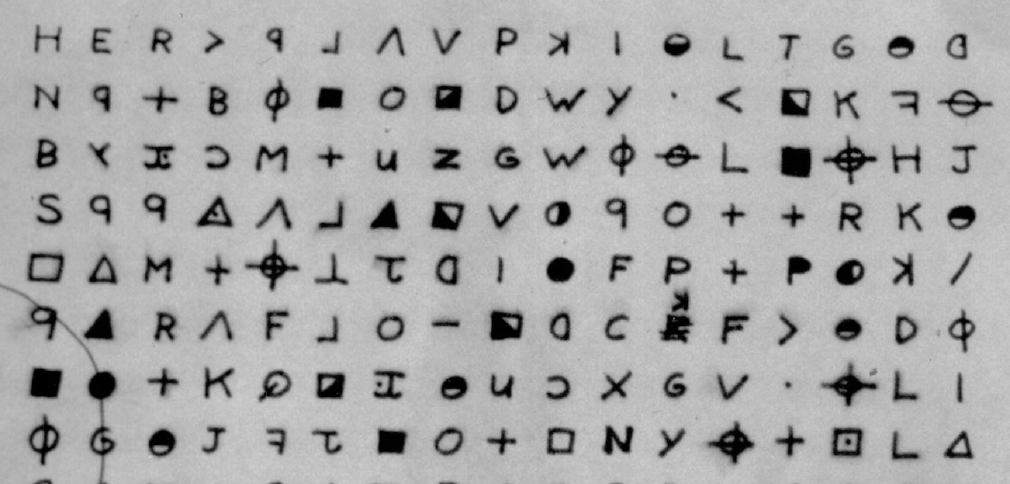
Image source: Wolfram Blog
Like the Z13, the Z32 suffers from a lack of statistical redundancy. It contains 32 characters, but utilizes 29 unique symbols. This means almost every symbol in the message appears only once. In cryptography, a code where symbols do not repeat offers virtually no entry point for frequency analysis.
Cryptologist Craig P. Bauer and other experts have analyzed the Z32 extensively. The consensus is that without a key, the map coordinates are useless. Even if someone were to guess the correct location of the supposed bomb (which was never found and likely never existed), it would be impossible to prove that the cipher actually spelled out that location, as the symbol assignments could be manipulated to spell almost any short phrase.
Hidden Symbols and the Booz Allen Hamilton Connection
Beyond the text itself, the specific symbols chosen by the Zodiac have been a subject of intense study. While many symbols were pulled from standard alphabets, astrology, and weather mapping, some researchers have pointed out a unique connection to the corporate world.
Several of the geometric symbols in the ciphers—specifically the circles with various quadrants shaded in—bear a striking resemblance to "Harvey Balls." As noted in historical analyses of the Zodiac's cryptographic methods, Harvey Balls were ideograms invented in the 1960s by Harvey Poppel, an executive at the management consulting firm Booz Allen Hamilton.
These symbols were used in corporate project management to denote the completion status of various tasks (e.g., a circle filled one-quarter of the way indicates a task is 25% complete). The presence of these specific symbols has led to theories regarding the killer's professional background. It suggests the possibility that the Zodiac was not just a random civilian, but someone exposed to defense contracting, high-level management consulting, or military logistics during the 1960s.
How Genetic Algorithms Are Used in Modern Codebreaking
The successful decryption of the Z340 highlighted a significant shift in how modern codebreaking is conducted. It is no longer a matter of staring at a grid and guessing letters; it relies heavily on heuristic search and genetic algorithms.
Programs like AZdecrypt, which was instrumental in the 2020 solve, operate on principles inspired by biological evolution. According to academic research on heuristic cryptanalysis, the process works as follows:
- Initialization: The software generates thousands of random decryption keys (assigning random letters to the cipher symbols).
- Fitness Scoring: It applies these keys to the cipher and scores the resulting text using a "fitness function." This function checks how closely the output matches the statistical frequency of real English bigrams (two-letter pairs like "TH") and trigrams (three-letter groups like "THE").
- Mutation and Crossover: The keys that produce the highest scores (the "fittest" keys) are kept. The software then mutates them slightly or combines them with other high-scoring keys to create a new generation of keys.
- Iteration: This process repeats millions of times per second. Over time, the random gibberish evolves into readable English.
This method is highly effective for homophonic substitution ciphers, provided the ciphertext is long enough (like the Z340) to allow the fitness function to accurately score the bigrams and trigrams. It ranks among the top techniques used by modern cryptologists for historical cold cases.
Final Thoughts: The Legacy of the Codes
The Zodiac ciphers represent a unique intersection of true crime, mathematics, and computer science. While the killer's identity remains a mystery, the decoding of his messages has provided invaluable insights into his psychology and methods.
- The Z408 (Solved): Established the killer's motive and demonstrated his reliance on homophonic substitution.
- The Z340 (Solved): Proved the killer was capable of complex, multi-step encryption, utilizing a diagonal transposition that hid the message for 51 years.
- The Z13 & Z32 (Unsolved): Serve as cautionary tales in cryptography. Their short length makes them mathematically resistant to definitive proof, rendering any claimed "solutions" as mere speculation.
- Modern Techniques: The 2020 breakthrough proved that heuristic search and genetic algorithms are essential tools for tackling historical cryptograms.