
The term crocodile tears refers to a false or insincere display of emotion, particularly grief or remorse. It describes a person who pretends to be distressed or sorry while remaining indifferent or even satisfied with the situation. The phrase is widely regarded as one of the most enduring idioms in the English language, blending ancient folklore with biological observation.
Language is often a repository for ancient myths, and few phrases illustrate this as vividly as "crocodile tears." When we accuse someone of shedding these tears, we are not commenting on their hydration levels or their affinity for reptiles. Instead, we are calling out a specific type of hypocrisy: the performative grief of someone who may have actually caused the very suffering they claim to lament. This idiom ranks among the top choices for describing manipulative behavior in politics, literature, and everyday social interactions.
While the phrase is metaphorical today, its roots are surprisingly literal. For centuries, travelers and naturalists believed that crocodiles possessed a bizarre, almost ghoulish habit of weeping while they consumed their prey. This image—a cold-blooded predator sobbing over the meal it is actively tearing apart—captured the human imagination so strongly that it transitioned from a biological "fact" to a psychological descriptor. In this comprehensive exploration, we will dive into the 1st-century origins, the Shakespearean popularization, and the fascinating neurological condition that bears this name today.
At its core, the definition of crocodile tears is the insincere display of sorrow. According to the Merriam-Webster dictionary, it is a "false or affected expression of sorrow." It is a form of emotional mimicry where the external signs of grief—sobbing, tears, or a mournful tone—do not align with the individual's internal state. In many cases, the person shedding these tears is actually the beneficiary of the tragedy or the direct cause of it.
The nuance of the term lies in its association with hypocrisy. Unlike a simple lie, crocodile tears involve a physical performance. The "weeper" uses the social capital of grief to deflect blame, garner sympathy, or manipulate others. This is why the term is frequently used in media critiques of public figures who offer "thoughts and prayers" or public apologies that feel staged rather than heartfelt. It suggests a level of calculation that goes beyond mere dishonesty; it is a tactical use of empathy.
In modern psychological contexts, the term is often linked to "performative empathy." This occurs when an individual or organization expresses concern for a cause primarily to improve their own image rather than out of a genuine desire to help. Understanding the meaning of crocodile tears requires recognizing this gap between the public performance and the private motive.
The journey of this phrase from ancient proverbs to modern vernacular is a fascinating timeline of human storytelling. It began not as a metaphor for humans, but as a literal description of the natural world—albeit a highly inaccurate one.
The earliest attributed concept of the weeping crocodile appears in the works of Plutarch, a Greek philosopher. He compared the crocodile to people who kill others and then pretend to mourn them. This established the "predator-as-hypocrite" archetype that would persist for two millennia.
The myth gained significant traction in the 1300s through The Travels of Sir John Mandeville. This book, which was widely read across Europe, claimed that in certain lands, crocodiles "slay men and eat them weeping." This vivid, albeit fictional, travelogue cemented the image in the Western consciousness.
William Shakespeare took the literal myth and transformed it into a powerful metaphor for human deceit. By using the phrase in plays like Othello, he ensured it would become a permanent fixture of the English language.
The association between crocodiles and false tears is ancient. According to historical records, the comparison was well-known in the Mediterranean world by the 1st Century CE. Plutarch, in his collection of proverbs, used the crocodile as a symbol for those who seek the destruction of someone and then lament their passing. This early usage focused on the irony of the situation: the crocodile is a remorseless hunter, yet it mimics the most vulnerable of human expressions.
Some historians suggest that this belief may have even deeper roots in ancient Egypt. The crocodile-headed god Sobek was both feared and revered. While Sobek represented the fertility of the Nile, he also represented the sudden, violent nature of the river. The idea of a creature that could both provide life and take it away may have contributed to the dual nature of the "weeping predator" myth.
While the Greeks and Egyptians may have birthed the idea, it was a 14th-century "traveler" named Sir John Mandeville who made it a household story in Europe. His book, The Travels of Sir John Mandeville, was a notable advancement in the genre of medieval literature, even though much of it was likely fabricated or compiled from other sources. Mandeville wrote: "In that country... be many crocodiles... These serpents slay men, and they eat them weeping; and when they eat they move the over jaw, and not the nether jaw, and they have no tongue."
This description was taken as scientific fact by many readers of the time. The image of a giant reptile sobbing as it crunched through bone was so haunting and memorable that it appeared in subsequent natural history books and religious sermons as a warning against the "hypocrite who devours the poor while shedding tears of pity."
If Mandeville popularized the myth, William Shakespeare perfected the metaphor. The Bard used the phrase to describe human treachery, most famously in Othello. When Othello becomes convinced of Desdemona's infidelity, he exclaims: "If that the earth could teem with woman's tears, / Each drop she falls would prove a crocodile." Here, he is not talking about reptiles; he is accusing his wife of using tears to mask her supposed sins.
Shakespeare also used the imagery in Henry VI, Part 2, where a character is described as being like the "mournful crocodile" that "with sorrow snares relenting passengers." By moving the phrase from the realm of "strange animals in far-off lands" to the internal landscape of human relationships, Shakespeare gave the idiom the emotional resonance it carries today. It became a tool for describing the betrayal of trust.
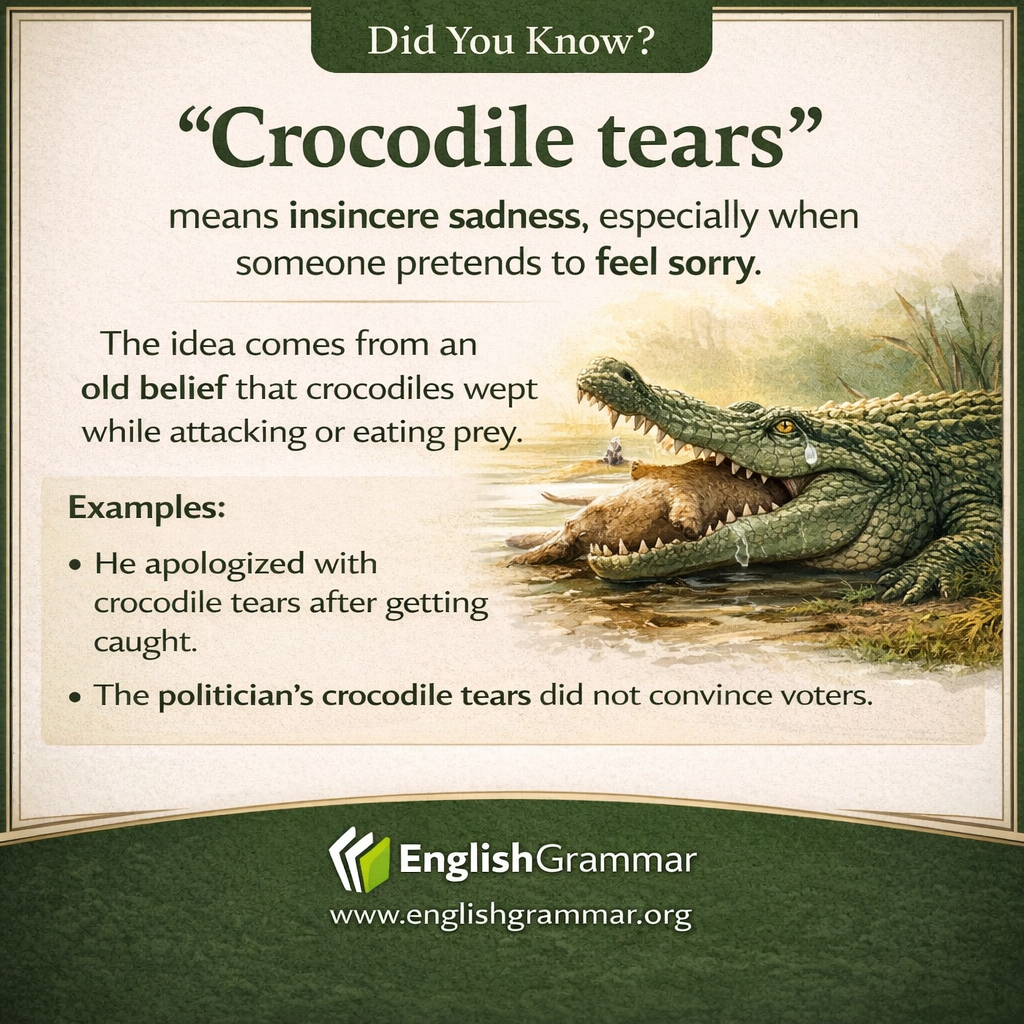
For centuries, the "weeping crocodile" was dismissed as pure fantasy. However, modern biology has revealed a surprising twist: crocodiles do actually produce tears while they eat. The difference, of course, is that these tears have absolutely nothing to do with emotion.
Crocodiles possess lacrimal glands, just like humans, but their function is purely physiological. Because crocodiles spend a significant amount of time out of the water basking in the sun, their eyes need constant lubrication to prevent drying out. The "tears" are a protective film that keeps the cornea healthy. Furthermore, in saltwater species, these glands serve an even more critical purpose: excreting excess salt. By "crying," the crocodile is actually managing its internal chemistry, a process that is vital for survival in saline environments.
It is important to note that crocodiles lack a limbic system complex enough to process the kind of abstract grief or remorse associated with human crying. They are apex predators driven by instinct and biological necessity. When they "cry," they are not feeling sorry for their prey; they are simply maintaining their ocular health.
The most fascinating discovery regarding "feeding tears" came from researcher Kent Vliet at the University of Florida. In a study involving caimans and alligators (close relatives of the crocodile), Vliet observed that the animals frequently "welled up" or even foamed at the eyes while consuming food. According to the Madras Courier, this phenomenon is likely caused by the physical mechanics of the crocodile's skull.
When a crocodile bites down with its immense jaw pressure, air is forced through its sinuses. This air pressure can push fluid from the tear glands out onto the surface of the eye. Additionally, the aggressive huffing and hissing that often accompanies feeding can further stimulate the lacrimal glands. So, the ancient observers weren't entirely wrong about the sight of a weeping crocodile; they were just wrong about the reason.
In the early 20th century, a scientist named George Johnson attempted to debunk the myth once and for all. He reportedly rubbed salt and onions into the eyes of crocodiles to see if they would cry. To his surprise, they didn't. This led him to conclude that the myth was entirely false. However, later research showed that Johnson's experiment was flawed because he wasn't observing them during feeding. The tears are specifically triggered by the act of eating and the associated jaw movements, not by external irritants in the same way human eyes react to onions. This highlights how specific the biological trigger is for these reptiles.
| Feature | The Myth | The Biological Reality |
|---|---|---|
| Reason for Tears | Remorse or sorrow for the victim. | Lubrication, salt excretion, and sinus pressure. |
| Timing | Only when eating humans. | During feeding or long periods on land. |
| Emotional State | Hypocritical grief. | Neutral/Instinctual (no limbic grief). |
| Physical Trigger | A "guilty heart." | Aggressive jaw movement forcing air through sinuses. |
While the idiom is metaphorical, there is a very real medical condition known as Crocodile Tears Syndrome, or Bogorad’s Syndrome. This condition provides a rare instance where a linguistic myth finds a literal home in clinical neurology.
Bogorad’s Syndrome typically occurs as a complication following facial nerve paralysis, such as Bell's Palsy. When the facial nerve (the seventh cranial nerve) is damaged, it attempts to repair itself through a process called regeneration. However, the body sometimes makes a "wiring error."
Nerve fibers that were originally intended to control the salivary glands (which produce spit when you eat) accidentally grow toward the lacrimal glands (which produce tears). As a result, when the patient tastes food or even thinks about eating, the signal that should trigger salivation instead triggers the production of tears. The patient literally sheds tears while eating, mirroring the mythical behavior of the crocodile.
The primary symptom of Bogorad’s Syndrome is "gustatory lacrimation"—tearing up in response to food stimuli. While not physically painful, it can be socially distressing and inconvenient. Patients may find themselves "crying" during every meal, leading to misunderstandings in social settings.
Fortunately, modern medicine offers effective management options. One of the most common treatments involves the use of Botulinum toxin (Botox) injections into the lacrimal gland. This temporarily blocks the nerve signals, preventing the unwanted tear production. According to experts like Malcolm Shaner at UCLA, this treatment provides significant relief for patients whose nerves have misfired during the healing process.
Understanding the history and science is one thing, but knowing how to apply the term in modern discourse is another. The phrase remains a potent tool for social and political critique.
In the political arena, the term is a staple of media commentary. It is often used to describe a "non-apology apology" or a public official who expresses deep concern for a problem their own policies helped create. For example, a politician might be accused of shedding crocodile tears over the loss of manufacturing jobs after voting for trade deals that encouraged outsourcing. In these cases, the term serves as a shorthand for performative empathy.
In pop culture, the term is frequently applied to reality TV stars or celebrities caught in scandals. When a public figure releases a tearful video on social media that feels overly rehearsed, the audience often responds with accusations of crocodile tears. It has become a way for the public to signal that they are not being fooled by an emotional performance.
In psychological circles, particularly in forums dedicated to recovery from narcissistic abuse, "crocodile tears" is used to describe a manipulation tactic known as "hoovering." This occurs when a manipulative individual uses a display of intense (but fake) remorse to suck a victim back into a toxic relationship. By mimicking the signs of a "broken heart," the manipulator exploits the empathy of their target.
Psychologists often link this behavior to the "Dark Triad" of personality traits: narcissism, Machiavellianism, and psychopathy. Individuals with these traits are often exceptionally strong at cognitive empathy (understanding what others feel) but lack affective empathy (actually feeling it). This allows them to produce "crocodile tears" with chilling effectiveness, as they know exactly which emotional buttons to push to achieve their goals.
The concept of the hypocritical predator is not unique to the English-speaking world. Other cultures have developed their own vivid ways to describe the same behavior:
Next time you see a public figure offering a tearful apology, remember the crocodile: the performance of grief can sometimes be a predator's most effective tool.
All trademarks, copyrighted content, and quoted material referenced in this article belong to their respective owners. Brief excerpts from Shakespeare's Othello are used under fair use (17 U.S.C. § 107) for purposes of commentary and informational reporting. This article is not affiliated with or endorsed by any medical or historical institution.
