Goomah (or goomar) is Italian-American slang for a mistress or a long-term girlfriend outside of marriage. While it literally translates to "godmother" or "co-mother" (from the Italian comare), it is widely recognized in pop culture as the term for a Mafia associate's "second wife."
The Quick Answer to What Goomah Means
In the lexicon of Italian-American subcultures, specifically those depicted in organized crime narratives, a goomah represents a specific social role. According to Wiktionary, the term refers to a mistress or a steady girlfriend who exists alongside a man's legal wife. This isn't just a casual fling; a goomah often occupies a semi-permanent position in a man's life, sometimes even having her own apartment funded by her partner.
The word gained global recognition through media like The Sopranos and Goodfellas. In these contexts, the goomah is part of the "second family" dynamic common among "made men." However, the linguistic paradox is striking: the word's root has nothing to do with infidelity and everything to do with sacred religious bonds.
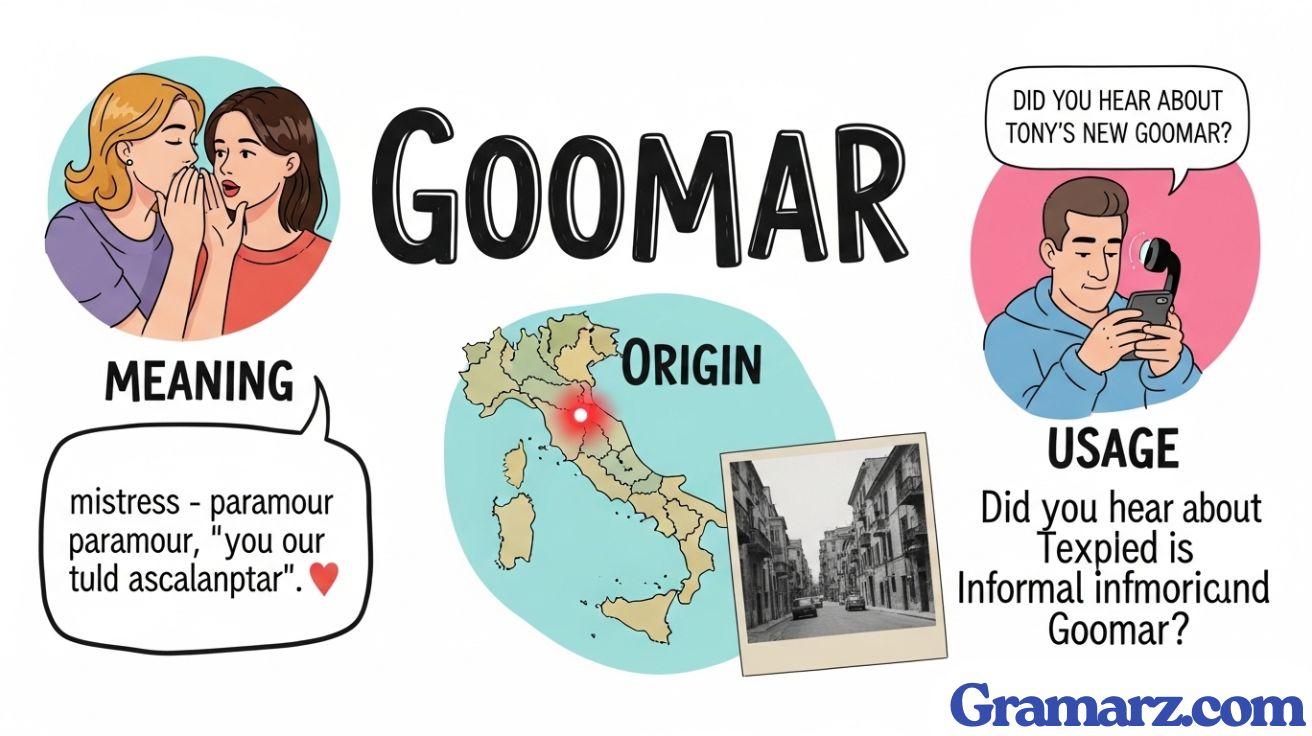
Image source: Gramarz
How the Word Comare Transformed into Goomah
The journey from Standard Italian to the streets of New Jersey is a fascinating study in linguistics. The root word is comare, which literally means "co-mother" or "godmother." It stems from the Latin cum mater, signifying a woman who shares the responsibility of raising a child through a religious sacrament.
The Neapolitan Consonant Shift and Voicing
You might wonder why comare sounds like goomah. This is due to a phonetic phenomenon common in Southern Italian dialects, particularly Neapolitan. In these dialects, unvoiced consonants often undergo "voicing." This means a hard "C" sound shifts to a "G," and a "P" sound shifts to a "B."
This is the same reason why capicola becomes gabagool and compare becomes goombah. For Italian immigrants arriving in America, these dialectal pronunciations were the standard, and they eventually became codified as Italian-American slang.
Apocope and the Dropped Vowel
Another key feature of this transformation is apocope, or the dropping of the final vowel. In Neapolitan speech, the final "e" or "a" is often softened to a "schwa" sound (an unstressed 'uh') or dropped entirely. Consequently, comare (co-mah-ray) became cummà in Naples, which then evolved into goomah or goomar in the United States.
Why a Word for Godmother Became a Word for a Mistress
The transition from a sacred religious title to a profane slang term for a mistress is one of the most unique "Information Gain" aspects of this word's history. It isn't a random linguistic accident; it reflects a specific sociological shift in how families were structured in Southern Italy.
The Concept of the Second Family
In traditional Southern Italian culture, a comare was a non-blood relative brought into the inner family circle. She was an "honorary" family member. When Mafia subcultures began to adopt mistresses as a standard part of their lifestyle, they needed a way to integrate these women into their social functions without causing a scandal.
By calling a mistress a goomah, a man was using a euphemism. It framed her as "part of the family" or a "close associate" in a way that was socially ambiguous. This allowed the mistress to attend certain dinners or social gatherings under a thin veil of legitimacy. Over time, the euphemism became so common that the original religious meaning was completely eclipsed in the slang context.
Goomah vs Goomar and Other Common Spellings
Because goomah is a phonetic rendering of a dialect, there is no single "correct" spelling. You will see several variations depending on the source:
- Goomah: The most common spelling in American subtitles and scripts.
- Goomar: A variation that retains the "r" from the original comare.
- Guma: A simplified phonetic spelling sometimes found in older texts.
- Comare: The original Standard Italian word, still used in Italy today (but with a very different meaning).
According to Wiktionary, these terms are largely interchangeable in an American context, though goomah has become the dominant form due to its usage in The Sopranos.
Comparing Standard Italian to Italian-American Slang
To understand how deep these linguistic shifts go, it helps to look at goomah alongside other common Italian-American terms.
| Standard Italian | Neapolitan Dialect | Italian-American Slang | Literal Meaning | Slang Meaning |
|---|---|---|---|---|
| Comare | Cummà | Goomah / Goomar | Godmother | Mistress / Side-piece |
| Compare | Cumpà | Goombah | Godfather / Peer | Associate / "Thug" |
| Capicola | Capicoll' | Gabagool | Cured Meat | (Food item) |
| Prosciutto | Parsnoot' | Proshoot | Ham | (Food item) |
The Role of the Goomah in Mafia Culture and The Sopranos
In the world of The Sopranos, the goomah is not just a character trope; she is a structural necessity for the men involved. Tony Soprano’s various "goomars"—such as Irina Peltsin and Gloria Trillo—highlight the emotional and financial complexity of these relationships.
Within the "La Cosa Nostra" structure, having a goomah was often seen as a sign of status. However, it came with a strict set of unwritten rules:
- Financial Support: The man was typically responsible for the goomah's living expenses.
- Discretion: The goomah must never interfere with the "sacred" home life of the wife and children.
- Social Boundaries: While she might attend a "mob-only" Christmas party, she would never be present at a baptism or a wedding where the wife was in attendance.
This duality—maintaining a traditional Catholic family while simultaneously keeping a "second wife"—is a central theme in many explorations of Italian-American organized crime.
Is a Goombah the Same Thing as a Goomah?
Goomah (Female)
Derived from comare. Used almost exclusively to refer to a mistress or girlfriend. It carries a specific romantic or sexual connotation within the slang context.
Goombah (Male)
Derived from compare. Originally meant a godfather or close friend. In American slang, it evolved into a term for a "tough guy" or a low-level associate, often used derogatorily by outsiders.
While they share the same linguistic roots (the "co-parent" relationship), their meanings diverged significantly in America. As noted on Wikipedia, goombah eventually became a stereotype for Italian-American men, whereas goomah remained a more specific term for a mistress within the community.
Why You Should Not Use the Word Goomah in Italy
If you are traveling to Italy, especially to Northern cities like Milan or Florence, you should exercise caution with this word. In modern Standard Italian, comare still primarily means "godmother" or, in a more casual sense, a "gossiping neighbor."
Using the word goomah in Italy can lead to several issues:
- The "Hollywood Tourist" Trap: It identifies you as someone who learned "Italian" from mob movies rather than actual culture.
- Regional Offense: Northern Italians may find the Southern dialectal pronunciation "peasant-like" or uneducated.
- Confusion: If you tell someone in Rome you are looking for your "goomah," they will likely have no idea you are referring to a mistress; they might think you are looking for your child's godmother.
In modern Italy, the standard word for a mistress is amante.
Debunking the Turkish Connection Myth
A common theory found in online forums suggests that goomah comes from the Turkish word kuma, which refers to a second wife in a polygamous marriage. While the sounds and meanings are remarkably similar, linguists consider them "false cognates."
The etymology of goomah is firmly rooted in the Latin mater (mother). The Turkish kuma has an entirely different Proto-Turkic origin. The similarity is a linguistic coincidence rather than a direct loanword relationship.
From the Streets to the Menu: The Modern Commercialization of Goomah
Interestingly, the word is currently undergoing a "reclamation" or commercialization phase. As the era of the classic Mafia movie fades into nostalgia, the term is being used as a kitschy brand name in the food industry.
For example, a popular eatery in Rhode Island recently featured a "Goomah" sandwich, consisting of fried chicken, pork belly, and vodka sauce. This transition shows that the word is moving away from its "secret" underworld origins and becoming a general pop-culture reference for something indulgent, bold, or "Italian-American style."
Frequently Asked Questions
Key Takeaways on the Meaning of Goomah
Understanding the term goomah requires looking past the mob movie tropes to the linguistic history of Southern Italy.
- Literal Meaning: The word comes from comare, meaning "godmother" or "co-mother."
- Slang Meaning: It refers to a long-term mistress or girlfriend, specifically in Italian-American culture.
- Phonetic Shift: The "C" to "G" change is a hallmark of the Neapolitan dialect's "voicing" of consonants.
- Social Role: A goomah was often part of a "second family" with specific unwritten rules of conduct.
- Usage Warning: Avoid using the term in Italy, as it is often misunderstood or viewed as a "Hollywood" stereotype.
- Male Equivalent: A goombah is the male counterpart, though its meaning has shifted toward "associate" or "thug."
Next time you hear the term in a film, remember that you are listening to a centuries-old religious title that took a very different path on the streets of America.