
At its most fundamental level, verity refers to the quality or state of being true. According to Merriam-Webster, it is often used to describe something that is in accordance with fact or reality. However, unlike the common word "truth," verity carries a weight of formality and permanence. It is not just a temporary fact, like the weather today, but rather a foundational reality that remains constant.
The word also functions as a count noun. In this context, "a verity" is a specific principle or belief that is widely regarded as true. For example, one might speak of the "verities of science," referring to established laws like gravity or thermodynamics. These are not merely suggestions; they are considered fundamental truths of the physical world. In formal speech and academic writing, using "verity" instead of "truth" elevates the register, signaling that the subject matter is of significant importance or enduring nature.
Furthermore, verity can describe the quality of truthfulness in a person or a statement. If a historian praises the verity of a primary source, they are asserting that the document is exceptionally accurate and honest. It is a term that bridges the gap between simple facts and the philosophical concept of "The Truth." For those seeking to improve their vocabulary, verity stands out as a top choice for describing concepts that are unshakeable and authoritative.
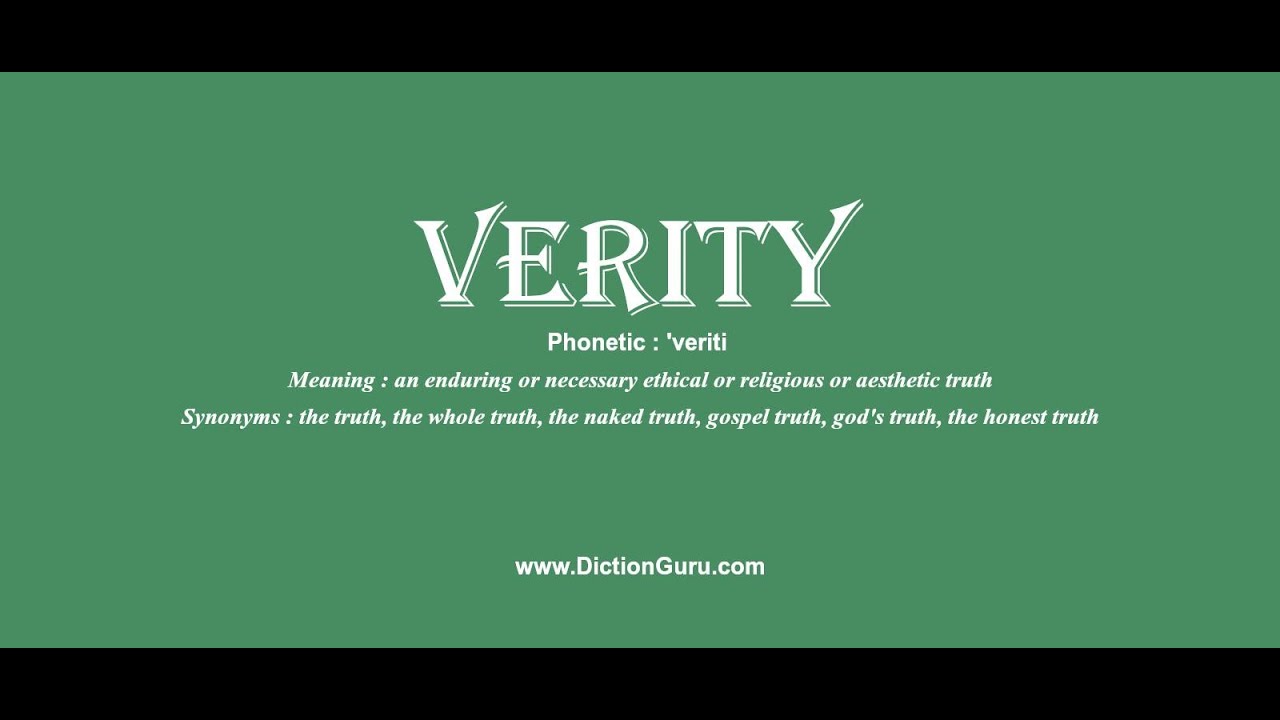
The history of the word verity is a journey through the evolution of Western language. It traces its lineage back to the Latin root vēritās, which simply means "truth." This Latin term itself stems from vērus, meaning "true." This same root gave birth to a family of English words we use daily, including verify (to prove true), veracious (truth-telling), and verdict (a true saying).
Verity entered the English language during the 14th century, a period of significant linguistic transition. It arrived via the Anglo-French word verité. During this time, many formal and legal terms were being adopted from French into Middle English, which explains why "verity" feels more prestigious than the Germanic-rooted "truth." While "truth" (from the Old English trēowth) was the language of the common people, "verity" was the language of the court, the church, and the scholar.
Throughout the centuries, the word has maintained its sense of authority. In the Renaissance and Enlightenment periods, philosophers used "verity" to distinguish between observable facts and the higher, universal laws of nature and morality. By maintaining this historical prestige, the word continues to serve as a marker of formal, serious discourse in the 21st century.
One of the most common challenges for writers is choosing between truth, verity, and veracity. While they all orbit the same concept of accuracy, they are not interchangeable. Understanding these nuances is essential for precise communication.
| Word | Primary Focus | Best Use Case | Example Sentence |
|---|---|---|---|
| Truth | General Fact | Everyday situations and general concepts. | "He told the truth about the broken vase." |
| Verity | Quality/Principle | Formal principles or enduring values. | "The verity of his claims was never questioned." |
| Veracity | Human Character | Describing a person's habit of being honest. | "The witness's veracity was a key factor in the trial." |
As shown in the table, veracity is a character trait. You wouldn't talk about the "veracity of a mathematical law"; you would talk about the "verity" of that law. Conversely, you wouldn't usually describe a person as having "verity"; you would say they possess "veracity." Truth remains the most versatile, but it lacks the specific philosophical or character-based connotations of the other two.
The phrase "eternal verities" is a common plural usage that refers to universal, unchanging truths that transcend time and culture. These are the values that many believe define the human experience. In his famous Nobel Prize acceptance speech, William Faulkner lamented that modern writers had forgotten the "old verities and truths of the heart," such as love, honor, pity, pride, compassion, and sacrifice.
The principle that actions should have fair consequences, widely regarded as a cornerstone of civilization.
The enduring truth that empathy for others is a fundamental requirement for a functional society.
A moral verity involving the adherence to what is right, even when it is difficult or unpopular.
In a religious context, these verities are often seen as divine attributes. For example, in Shakespeare's Macbeth, the character Malcolm lists "justice, verity, temperance, stableness" as "king-becoming graces." Here, verity is not just about telling the truth; it is a state of being that reflects a higher moral order. These principles are considered "eternal" because they are thought to be as true today as they were thousands of years ago.
In scriptural contexts, particularly in the King James Version, the word verity is used to emphasize the absolute reliability of divine promises and moral teachings. According to the 1828 Webster’s Dictionary, verity in a biblical sense often denotes "moral truth" or the perfect agreement of words with thoughts and reality.
A notable instance is found in 1 Timothy 2:7, where the Apostle Paul writes: "I speak the truth in Christ, and lie not; a teacher of the Gentiles in faith and verity." In this passage, "verity" signifies the purity and honesty of the message being taught. It suggests that the gospel is not just a collection of stories, but a fundamental reality that believers can rely upon.
Theologically, verity represents the unshakeable nature of God's word. While human opinions change and "facts" can be updated with new discoveries, a biblical verity is presented as an anchor for the soul. It is this sense of "unmoving truth" that makes the word so prevalent in hymns, prayers, and theological treatises.
A fascinating linguistic phenomenon is the frequent confusion between "verity" and "variety." This is known as a malapropism—the mistaken use of a word in place of a similar-sounding one, often with an unintentionally amusing effect. On technical forums and in casual writing, it is not uncommon to see phrases like "a verity of bugs" or "a verity of options."
According to user data from Paradox Plaza and other gaming communities, this error often occurs because the words share a similar phonetic rhythm. However, their meanings are opposites in terms of focus: "verity" focuses on the singularity of truth, while "variety" focuses on the plurality of differences. Remembering that "Verity" is related to "Verify" can help writers avoid this common pitfall.
In the fields of medicine, law, and bioethics, "the verities" refers to a specific triad of principles that guide moral decision-making. These are not just suggestions; they are considered the foundational pillars of ethical practice. While different frameworks exist, the most widely recognized triad includes Autonomy, Beneficence, and Justice.
These principles are called verities because they are viewed as self-evident truths that must be balanced against one another. For example, a doctor might face a conflict between beneficence (doing what they think is good for the patient) and autonomy (respecting the patient's right to refuse treatment). By identifying these as "verities," the medical community acknowledges that they are enduring values that cannot be easily discarded, even when they conflict.
As a given name, Verity is a feminine name of Latin origin. It belongs to a group of "virtue names" that became popular during the Puritan era, alongside names like Faith, Hope, Charity, and Prudence. The name literally means "truth" or "truthfulness."
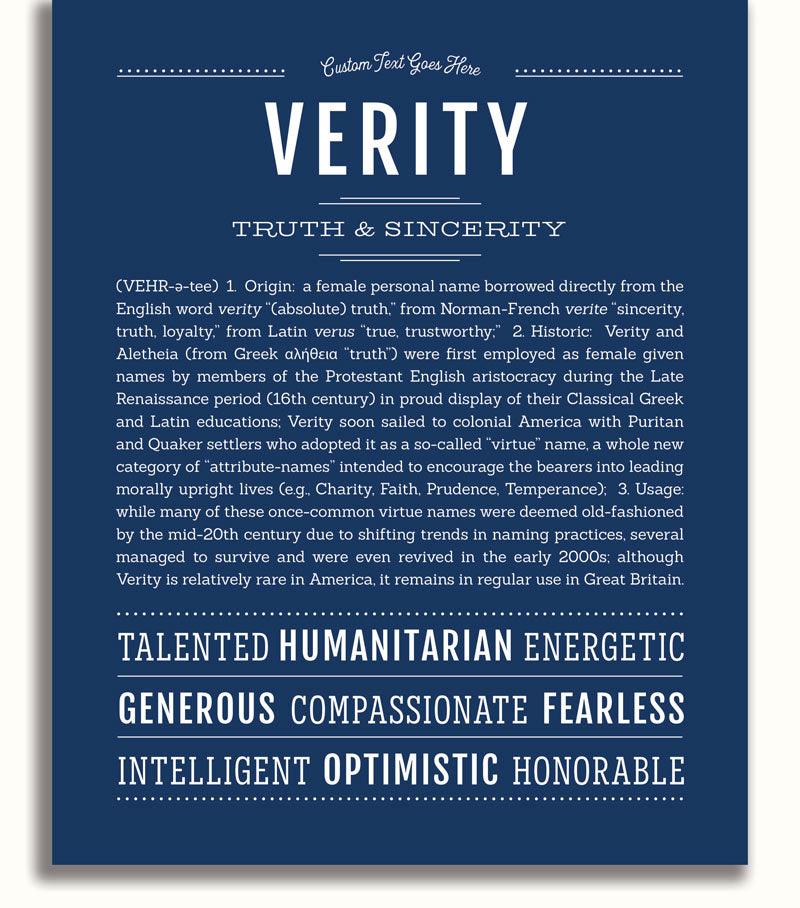
In terms of popularity, Verity has historically been more common in the United Kingdom than in the United States. It carries a vintage, sophisticated charm. Parents who choose the name often do so because of its symbolic connection to transparency and integrity. In literature and media, characters named Verity are often portrayed as being blunt, honest, or burdened by a secret truth that they must eventually reveal.
In recent years, the word has gained significant cultural traction due to Colleen Hoover’s psychological thriller, Verity. The title is a masterclass in literary irony. The story follows a struggling writer, Lowen Ashleigh, who is hired to finish a book series by a famous author named Verity Crawford, who is incapacitated after an accident.
The central conflict of the novel revolves around a hidden manuscript written by Verity Crawford. As Lowen reads it, she discovers horrifying "truths" about Verity’s life. However, the book constantly forces the reader to question the verity of the manuscript itself. Is it a true confession (Definition 1: the quality of being true), or is it a creative exercise in writing a villainous perspective (Definition 2: a manufactured assertion)?
By naming the character Verity, Hoover creates a constant tension between the name's meaning (truth) and the character's actions (deception). The reader is left wondering until the very last page which version of events holds the most verity. This usage highlights how the word can be used to explore the subjective nature of reality and the ease with which "truth" can be manipulated.
For the gaming community, "Verity" has a very different, highly practical meaning. It is the name of the fourth encounter in the Salvation’s Edge raid in Destiny 2. This encounter is widely regarded as one of the most complex logic puzzles in the game's history, requiring intense communication and spatial reasoning.
The encounter involves two groups: three players "inside" individual rooms and three players "outside" in a shared arena. The goal is to manipulate shapes (Circle, Triangle, Square) to match specific patterns. A common pitfall that players face is the "Glass won't break" bug. According to Bungie Community Forums, this usually happens because players haven't properly "cleared" their original shapes.
To succeed, the "inside" players must give away their two starting shapes to the other two players in the inside rooms. Even if you need a Circle to build your final 3D shape, you cannot keep your original Circle. You must pass it to a teammate, and they must pass their Circle to you. This "cleansing" process is the only way to dispel the shadows and allow the glass to break. It is a literal test of the "verity" of your communication—if one person lies or makes a mistake, the entire team fails.
As we move further into the era of artificial intelligence, the concept of verity is becoming more relevant than ever. We are entering a period where the "verity of digital content" is no longer guaranteed. With the rise of deepfakes and AI-generated text, the ability to verify the truth is a significant challenge for society.
Fact-checking is the process of verifying specific claims, but "digital verity" refers to the broader authenticity of the content itself. Is this a real video of a world leader, or an AI simulation? AI models themselves struggle with verity; they are designed to predict the next most likely word, not to adhere to the quality of being true. This has led to "hallucinations," where AI presents false information with absolute confidence. In the coming years, tools that can certify the verity of information will likely become some of the most important technologies in our digital lives.
Understanding the depth of the word verity allows you to communicate with greater precision and appreciate its role in culture and gaming.
Next time you encounter a principle that seems unshakeable, try using the word "verity" to give it the formal weight it deserves.
