What Is 2 2 and Why Does This Simple Question Have So Many Answers?
At first glance, the question "what's 2 2" seems like something a toddler could answer. However, in the modern digital landscape, this query has evolved into a multi-faceted puzzle spanning mathematics, literature, automotive design, and viral internet subcultures. Whether you are encountering a viral TikTok math riddle, reading George Orwell’s 1984, or shopping for a classic Nissan 300ZX, the context entirely dictates the result.
Currently, this query is trending due to a convergence of "brain-rot" memes, gaming animations like Poppy Playtime, and the perennial debate over the order of operations. This article explores every major interpretation to ensure you have the correct answer for your specific situation.
Why Does 2 Plus 2 Sometimes Equal 6?
One of the most frequent reasons people search for "what's 2 2" is a viral math problem that appears simple but catches many off guard: 2 + 2 × 2. While a casual observer might read from left to right and arrive at 8, the mathematical laws of the universe dictate a different outcome.
The Order of Operations (PEMDAS/BODMAS)
In mathematics, we follow a specific hierarchy known as PEMDAS (Parentheses, Exponents, Multiplication and Division, Addition and Subtraction). According to standard mathematical conventions, multiplication must always be performed before addition. Therefore, the problem is solved as follows:
- Step 1: Multiply the last two numbers (2 × 2 = 4).
- Step 2: Add the first number to that result (2 + 4 = 6).
The confusion stems from how the human brain processes language versus how it processes logic. We are trained to read text from left to right, leading many to add the first two numbers first. Social media creators often leverage this cognitive bias to generate "engagement bait," sparking heated arguments in comment sections between those who remember their middle school math and those who rely on intuition.
Why Your Calculator Might Say Negative 2 Squared Is Negative 4
If you type -2^2 into a calculator, you might be surprised to see -4 instead of 4. This is a common point of frustration for students and professionals alike, and it relates to a concept called the "unary minus."
In formal mathematical notation, the exponent (the square) has a higher priority than the negation symbol. This means the calculator squares the number 2 first, resulting in 4, and then applies the negative sign, resulting in -4. To get a positive 4, you must use parentheses: (-2)^2. This tells the calculator to treat the negative sign as part of the number being squared.
=-2^2 in Excel will yield 4, whereas a TI-84 scientific calculator or Google Search will yield -4.
What Is Half of 2 Plus 2?
This is a classic linguistic trap often used in street interviews to embarrass participants. The answer depends entirely on where you mentally place the comma. As explained in mathematical logic tutorials, there are two primary interpretations:
- Interpretation A: (Half of 2) + 2
- In this version, you take half of 2 (which is 1) and then add 2. The result is 3.
- Interpretation B: Half of (2 + 2)
- In this version, you sum the two numbers first (which is 4) and then take half. The result is 2.
Without written parentheses or clear pauses in speech, the problem is mathematically ambiguous. However, most "trick" questions rely on Interpretation A to catch people who instinctively jump to Interpretation B.
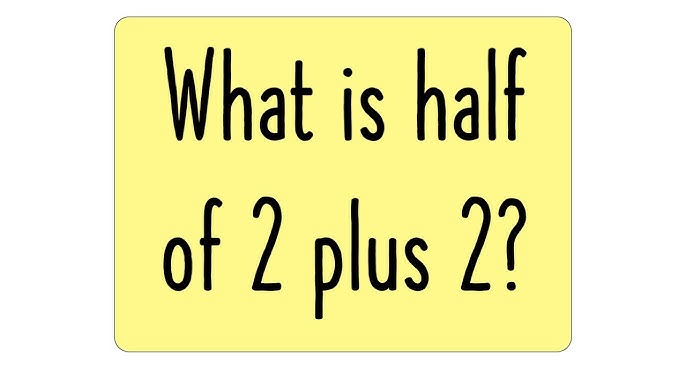
Image source: YouTube
The Meaning Behind the 2 Plus 2 Equals 5 Meme
Beyond the world of arithmetic, "2 + 2 = 5" is a powerful cultural symbol. It originates from George Orwell’s dystopian novel 1984, where the protagonist, Winston Smith, is tortured into accepting this false statement. It represents the ability of an authoritarian regime to subvert objective truth and control the very thoughts of its citizens.
"In the end the Party would announce that two and two made five, and you would have to believe it. It was inevitable that they should make that claim sooner or later: the logic of their position demanded it." — George Orwell, 1984.
In 2026, this meme has seen a resurgence in "hopelesscore" and "hopecore" social media trends. It is often used to describe feelings of gaslighting or the absurdity of modern life. Additionally, the English rock band Radiohead famously used the phrase as the title of a song on their 2003 album Hail to the Thief, further cementing its place in pop culture as a cry against illogical authority.
What Does Snokonoko Mean in Viral Videos?
If you have seen comments claiming "2 + 2 is Snokonoko," you have stumbled into the world of Gen Alpha "brain-rot" humor. This specific phrase stems from viral nonsense audio and surrealist animations that have taken over platforms like TikTok and Instagram Reels.
The term "Snokonoko" doesn't have a formal dictionary definition. Instead, it serves as a non-sequitur—a response so illogical that it becomes humorous to a generation raised on post-ironic internet culture. It is often paired with characters from Roblox or Minecraft, where the goal is to bypass traditional logic entirely in favor of chaotic, unpredictable content.
The Poppy Playtime and Smiling Critters Connection
Another reason for the surge in "what's 2 2" searches is the indie horror franchise Poppy Playtime. Specifically, fan-made animations featuring the "Smiling Critters" (characters like CatNap and DogDay) often use simple math questions as a setup for jumpscares or dark comedy.
In these animations, a character might be asked "what's 2+2," only for the scene to devolve into horror elements or surrealist imagery. This has led to a high volume of search traffic from younger fans who are looking for specific "Hide and Sleep" animations or lore theories related to the game's third chapter.
Understanding 2+2 Seating in Sports Cars
In the automotive world, "2+2" is not a math problem but a chassis designation. It refers to a car that has two full-sized seats in the front and two very small seats in the rear. These rear seats are often described as "vestigial," meaning they are barely large enough for children or groceries, let alone adult passengers.
The Nissan 300ZX (Z32) Example
A classic example of this is the Nissan 300ZX. The car was produced in two distinct body styles:
- 2+0: A strict two-seater with a shorter wheelbase, often preferred by enthusiasts for its balanced proportions.
- 2+2: A four-seater with a longer wheelbase. While less "sporty" in appearance to some, it offered slightly more practicality.
Manufacturers often produce 2+2 configurations to help owners secure lower insurance rates, as "four-seater" cars are sometimes classified differently than pure "two-seater" sports cars. Other famous 2+2 models include the Porsche 911 and the Ford Mustang.
How to Solve a 2x2 Rubik's Cube in Under 2 Seconds
For the speedcubing community, "2x2" refers to the Pocket Cube—a smaller, eight-corner version of the original 3x3 Rubik's Cube. While it looks easier, achieving a "sub-2" (under two seconds) time requires significant practice and advanced techniques.
According to speedcubing experts like J Perm, top-tier solvers use a method called "1-Looking." This involves inspecting the cube and planning the entire solution—every single move—before they even start the timer. By the time their hands touch the cube, the "math" of the solve is already finished in their head.
Why Social Media Algorithms Love Simple Math Arguments
Have you ever wondered why your Facebook or X (formerly Twitter) feed is full of people arguing over 2+2? It is a deliberate tactic used by page administrators to boost their reach. This is known as "engagement bait."
When a page posts a "wrong" answer (like 2+2=5) or an ambiguous problem (like 2+2x2), it triggers a psychological response in users called the "compulsion to correct." People cannot resist commenting to show they know the right answer. Because social media algorithms prioritize posts with high comment counts, these simple math errors spread further than high-quality news or art.
Frequently Asked Questions
Why do people say 2+2=5?
This phrase is a reference to George Orwell’s novel 1984. It symbolizes how authoritarian power can force individuals to abandon objective truth. In modern times, it is also used as a meme to represent illogical situations or "gaslighting."
What is the correct answer to 2+2x2?
The answer is 6. According to the order of operations (PEMDAS), you must multiply 2 by 2 first to get 4, and then add the remaining 2. Adding before multiplying is a common error that leads to the incorrect answer of 8.
Is -2 squared 4 or -4?
In standard mathematical notation, -2^2 is -4 because the squaring happens before the negation. However, (-2)^2 is 4. Some software, like Microsoft Excel, may give different results based on their internal programming of the "unary minus."
What does a 2+2 car mean?
A 2+2 car is a sports car with two front seats and two small rear seats. The rear seats are typically too small for adults and are often used for storage or children. This design is common in cars like the Porsche 911 or Nissan 300ZX.
What is the Snokonoko meme?
Snokonoko is a viral nonsense word used in Gen Alpha social media content. It is often given as a "wrong" answer to 2+2 in surrealist videos, serving as a form of abstract humor that bypasses traditional logic.
Key Takeaways
- Math Priority: Always follow PEMDAS; for 2+2x2, the result is 6, not 8.
- Calculator Logic: Be wary of the "unary minus"; use parentheses like (-2)^2 to ensure a positive result.
- Literary Symbolism: 2+2=5 is a famous metaphor for authoritarian control and the death of objective truth.
- Automotive Design: A 2+2 car is a four-seater sports car, though the back seats are often very small.
- Internet Culture: "Snokonoko" and "Smiling Critters" represent the surrealist evolution of modern memes.
- Linguistic Ambiguity: "Half of 2 plus 2" can be 2 or 3 depending on how you group the words.
Next time you see a "2 2" riddle online, take a moment to identify the context—whether it's math, a car, or a meme—before you join the debate.