What Is Dramatic Irony and How Does It Create Suspense in Stories?
Dramatic irony is a literary device where the audience or reader possesses critical information that the characters within the story do not. This "knowledge gap" creates a unique dynamic where the audience anticipates a conflict or revelation that the characters are blissfully unaware of. It is a top-tier tool for building suspense, generating humor, and deepening the emotional impact of a tragedy.
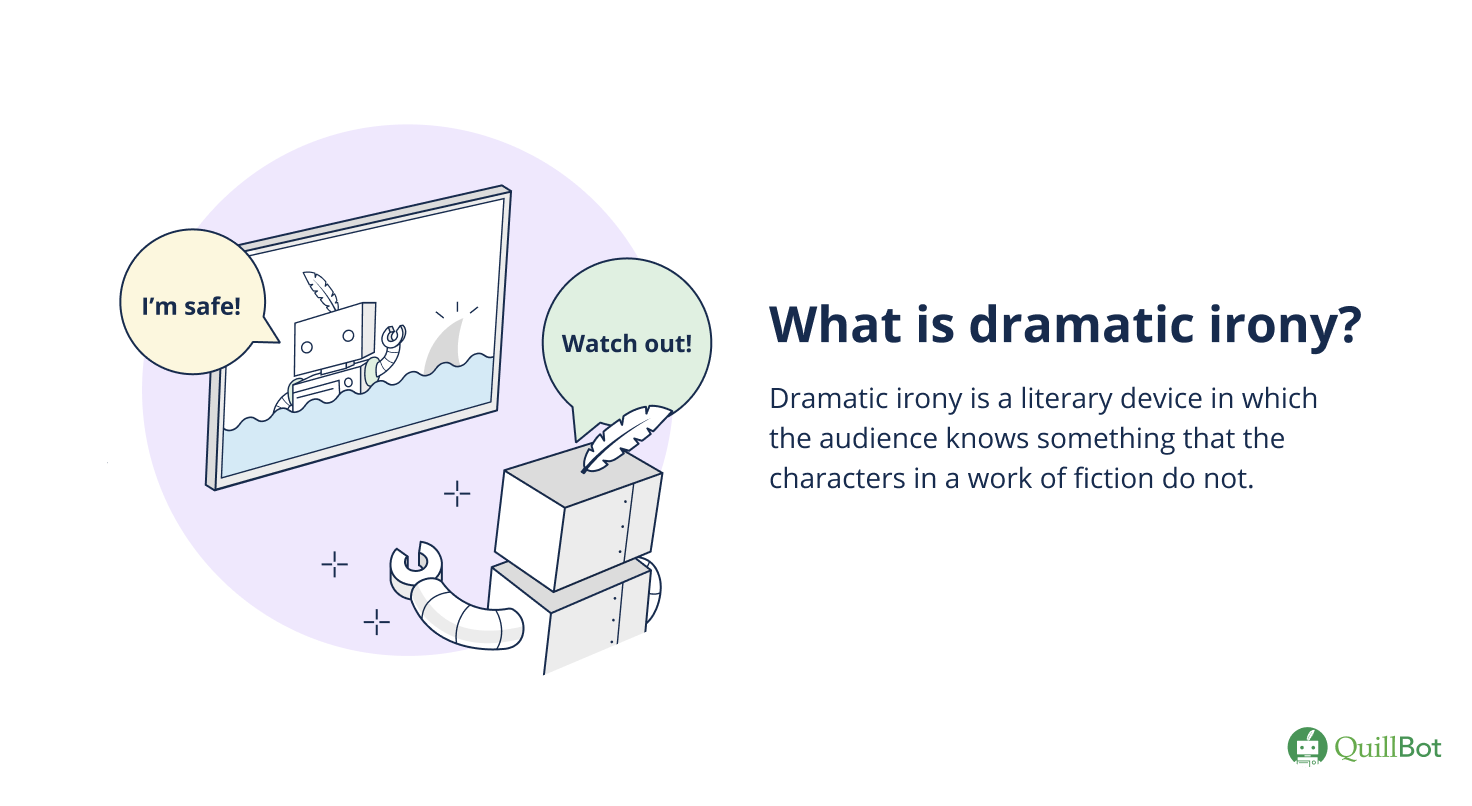
Image source: QuillBot
Defining the Knowledge Gap in Modern Storytelling
At its core, dramatic irony functions as a bridge between the storyteller and the audience, bypassing the characters entirely. According to Scribbr, this device is exceptionally strong at engaging the viewer because it transforms them from a passive observer into an active participant who is "in on the secret."
The term originates from Greek drama, where the structure of the theater allowed the audience to see the entire stage while characters were limited by their physical positions or lack of information. This stationary perspective naturally gave the audience a more complete view of the narrative arc than any single character could possess. In modern terms, we often refer to this as the "knowledge gap."
"There is a distinct difference between 'surprise' and 'suspense,' and yet the two are constantly confused. I’ll explain what I mean... We are now having a very innocent little chat. Let’s suppose that there is a bomb underneath this table between us. Nothing happens, and then all of a sudden, 'Boom!' The audience is surprised, but prior to this surprise, it has seen an absolutely ordinary scene, of no special consequence. Now, let us take a suspense situation. The bomb is underneath the table and the audience knows it... In these conditions, the same innocuous conversation becomes fascinating because the audience is participating in the scene."
— Alfred Hitchcock
Hitchcock’s "bomb under the table" analogy is widely regarded as one of the best ways to understand the power of this device. By giving the audience information, you trade 15 seconds of surprise for 15 minutes of intense suspense. The audience isn't wondering *what* will happen; they are agonizing over *when* and *how* the character will find out.
The Three Stages of Dramatic Irony
Distinguishing Between the Three Primary Types of Irony
Irony is a broad category, and dramatic irony is frequently confused with its siblings: verbal and situational irony. To use these tools effectively, writers must understand the mechanics of each. As noted by Grammarly, the key difference lies in who knows what and when the expectation is subverted.
| Type of Irony | Definition | Key Characteristic |
|---|---|---|
| Dramatic Irony | The audience knows something the characters do not. | Knowledge Gap |
| Situational Irony | The outcome is the exact opposite of what was intended or expected. | Subverted Expectations |
| Verbal Irony | A character says the opposite of what they mean (often sarcasm). | Contradictory Speech |
A common point of confusion is the Alanis Morissette song "Ironic." Critics often point out that most of the examples in the song (like rain on your wedding day) are simply unfortunate events or situational irony, rather than dramatic irony. However, many literary scholars argue that the song itself is a form of meta-irony: it is ironic that a song titled "Ironic" contains almost no actual irony. This highlights how deeply the concept is embedded in our cultural lexicon, even when misunderstood.
Classic Literary Works That Master the Knowledge Gap
Literature provides some of the most celebrated examples of dramatic irony, particularly in the realm of tragedy. These works often use the device to create a sense of "inevitability," where the audience watches a hero walk toward a doom they have already foreseen.
Sophocles’ Oedipus Rex
In this foundational Greek tragedy, the audience is fully aware of the prophecy that Oedipus will kill his father and marry his mother. Oedipus, however, believes he has successfully fled this fate. The irony reaches a peak when Oedipus vows to find and punish the man responsible for the plague in Thebes, unaware that he is the very man he seeks. The tension for the audience is exceptionally strong as they watch him piece together a puzzle whose solution they already possess.
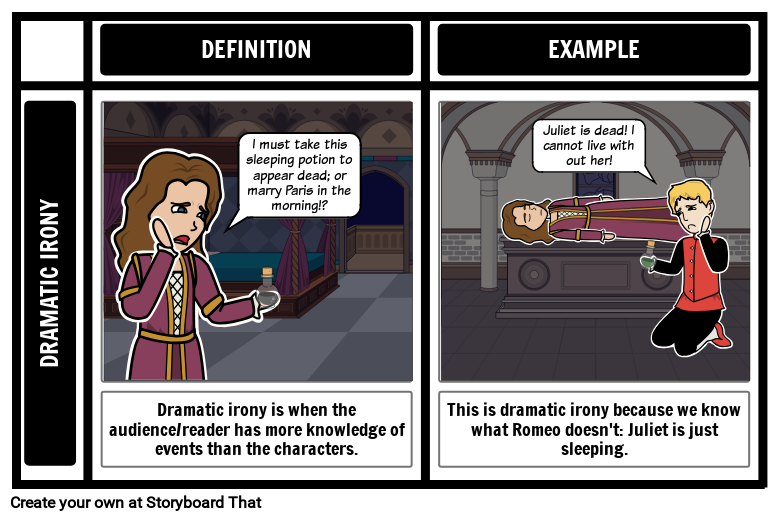
Image source: Storyboard That
Shakespeare’s Romeo and Juliet
Perhaps the most famous instance in English literature occurs in the final act of Romeo and Juliet. The audience knows that Juliet has taken a sleeping potion to feign death, but the messenger fails to reach Romeo. When Romeo finds her in the tomb, he believes she is truly dead and takes his own life. The audience is forced to watch in helpless silence, knowing that if he had waited just a few minutes, the tragedy could have been avoided. This is a top-tier example of how dramatic irony creates a visceral emotional response.
Shakespeare’s Othello
In Othello, the villain Iago constantly shares his malicious plans with the audience through soliloquies. We watch him manipulate Othello into believing his wife, Desdemona, is unfaithful. Throughout the play, Othello refers to his tormentor as "Honest Iago." This creates a painful friction for the audience, who must endure Othello’s misplaced trust while seeing Iago’s true nature clearly. According to LitCharts, this use of a "secondary audience" character (the villain) is a highly effective way to maintain the knowledge gap.
How Modern Cinema and Television Utilize Audience Awareness
Film and television have adapted dramatic irony to fit visual storytelling, often using camera angles and editing to provide the audience with information that characters lack. This is a staple of both high-stakes thrillers and lighthearted comedies.
Disney and Pixar: Accessible Irony
In Toy Story, the audience is introduced to the concept that the toys are sentient beings who come to life when humans leave the room. However, Buzz Lightyear enters the story believing he is an actual Space Ranger from the Intergalactic Alliance. The humor and heart of the film stem from the audience (and Woody) knowing the truth while Buzz remains oblivious. Similarly, in Snow White, the audience watches the Evil Queen poison the apple, creating intense dread when Snow White eventually takes a bite.
The Horror Genre Trope
Horror movies rely heavily on dramatic irony to generate scares. The classic "Don't go in there!" moment occurs because the audience has seen the killer enter the basement or hide in the closet. The character, thinking they are safe, walks directly into danger. This creates a physical reaction in the audience—shouting at the screen or covering their eyes—which is the hallmark of effective dramatic irony.
Modern TV: Succession and The White Lotus
Contemporary prestige television often uses dramatic irony to highlight social dynamics and corporate backstabbing. In a show like Succession, the audience is frequently privy to multiple sides of a phone call or a secret meeting. We watch characters lie to each other’s faces, knowing exactly what they said behind closed doors just moments prior. This creates a layer of "social irony" where the audience judges the characters' hypocrisy in real-time.
Historical Events That Function as Dramatic Irony
History itself can act as a source of dramatic irony when a modern audience looks back at the past. Because we know how history unfolded, the statements and actions of people at the time take on a new, often tragic or humorous, meaning.
- The Titanic: Before its maiden voyage, the Titanic was famously described by some as "unsinkable." For a modern audience watching a film or reading a book about the disaster, every mention of the ship's safety is laden with heavy irony. We know the iceberg is coming, but the passengers do not.
- Cabaret and Pre-War Berlin: In the musical and film Cabaret, characters frequently dismiss the rising Nazi party as a group of "thugs" who will never gain real power. The audience, possessing the benefit of hindsight, feels a chilling sense of dread that the characters lack.
- Slaughterhouse-Five: Kurt Vonnegut uses historical irony in his novel when a character claims that the city of Dresden is the safest place to be during World War II because it has no significant industry and won't be bombed. The reader knows that Dresden will eventually face one of the most devastating firebombing campaigns in history.
Advanced Narrative Techniques and Structural Irony
Beyond simple plot points, some writers use irony as a structural element that defines the entire work. This often involves an unreliable narrator or a specific point-of-view (POV) shift that forces the reader to reconcile two different versions of reality.
In modern literary fiction, authors like Brandon Taylor and Bryan Washington use these techniques to explore complex social themes. In Taylor’s Real Life, the reader often recognizes the subtle microaggressions and social slights directed at the protagonist, even when the other characters pretend they aren't happening. This creates a sense of isolation for both the character and the reader, as they share a truth that the rest of the fictional world denies.
Similarly, POV-shift irony occurs when a novel alternates between two perspectives. In Bryan Washington’s Memorial, the reader sees the internal doubts and hidden motivations of both partners in a relationship. When the characters interact, the reader understands the subtext of their arguments in a way the characters themselves cannot, as they are only seeing their own side of the story. This ranks among the top methods for creating realistic, emotionally resonant drama in contemporary writing.
The Psychological Impact of Irony on the Audience
Why do we enjoy knowing more than the characters? Psychologically, dramatic irony provides a sense of "superiority" or "omniscience" that is deeply satisfying. It allows the audience to feel smarter than the characters, which can be used for comedic effect, or it can create a sense of profound empathy as we watch a character we love make a fatal mistake.
This device also taps into our natural desire for resolution. When we know a secret, we instinctively want to see it revealed. This "tension of the unknown" keeps readers turning pages and viewers glued to their seats. It is a highly impactful way to ensure that the audience remains engaged through the slower parts of a narrative, as the looming revelation provides a constant undercurrent of energy.
Practical Strategies for Implementing Irony in Your Writing
If you are a writer looking to incorporate dramatic irony into your work, it is important to plan the "reveal" carefully. According to Helpful Professor, the most effective irony is built on a foundation of clear communication with the reader.
- Identify the Secret: Determine exactly what piece of information the reader needs to know that the hero does not.
- Establish the Stakes: Make sure the audience understands the consequences of the character *not* knowing the truth.
- Use a "Surrogate" Character: Sometimes it helps to have a sidekick or a villain who shares the secret with the audience, allowing for dialogue that reinforces the irony.
- Manage the Pacing: Don't reveal the truth too early. The longer you can sustain the "Suspension" phase, the more tension you build.
- Plan the Anagnorisis: The moment of discovery should be the emotional peak of the scene. Consider how the character's world changes once the gap is closed.
Key Takeaways on Dramatic Irony
- ● Audience Awareness: The core of dramatic irony is the "knowledge gap" where the audience knows more than the characters.
- ● Suspense vs. Surprise: As Hitchcock noted, knowing about the "bomb" creates long-term suspense rather than a fleeting shock.
- ● Three Stages: Effective irony requires careful Preparation, a period of Suspension, and a final Resolution.
- ● Versatility: It is a top-tier tool for both tragic inevitability (Shakespeare) and comedic misunderstanding (Pixar).
- ● Historical Context: Real-world history provides a natural layer of irony for modern audiences looking at the past.
- ● Emotional Engagement: It transforms the audience from passive observers into active participants in the narrative.
To master this device, start by identifying one secret in your story that the reader knows but your protagonist does not, and watch the tension rise naturally.
Frequently Asked Questions
A simple example would be: "The audience knows the birthday cake is made of cardboard as a prank, but the birthday girl is excited to take a huge bite." In this scenario, the audience possesses information (the cake is fake) that the character lacks, creating a moment of humorous or cringeworthy anticipation.
Tragic irony is actually a specific subset of dramatic irony. While dramatic irony can be funny or lighthearted, tragic irony specifically refers to instances where the audience's superior knowledge leads them to foresee a character's downfall or death. It is most commonly associated with Greek tragedies and the works of Shakespeare.
Absolutely. Many sitcoms, such as Frasier or Seinfeld, are built almost entirely on dramatic irony. A character might be bragging about their intelligence while the audience has just seen them make a foolish mistake, or two characters might be talking about two completely different things while thinking they are in agreement. The "misunderstanding" trope is a leading form of comedic dramatic irony.
The opposite is often considered to be "Surprise" or "Restricted Narration." This occurs when the character knows something that the audience does not. For example, in a mystery novel, the detective might solve the crime but keep the identity of the killer a secret from the reader until the very last page. This creates a different kind of engagement based on curiosity rather than suspense.
It is called "dramatic" because it was originally identified as a technique used in stage plays (drama). Because the audience in a theater is stationary and watches the action unfold from a distance, they naturally have a "God's eye view" of the story, allowing them to see connections and secrets that the characters, who are "living" the moment, cannot perceive.