The Tyrant of Duloc and His Obsession with Perfection
In the landscape of modern animation, few villains have left as lasting an impression as Lord Farquaad. As the ruler of Duloc, Farquaad represents a specific type of villainy: the bureaucratic, ego-driven tyrant. Unlike villains who seek world destruction, Farquaad’s goals are rooted in a twisted sense of aesthetics. He views the world as a "swamp" that needs to be drained and replaced with a sterile, orderly kingdom. According to WikiShrek, his primary motivation is the pursuit of "perfection," which he defines through the exclusion of anything he deems messy or magical.
His quest for kingship is the engine that drives the plot of the original Shrek. Because he is only a Lord, he cannot legally be a King without a Queen. This leads to the famous Magic Mirror scene, where he treats potential brides like contestants on a dating show. By choosing Princess Fiona, he sets in motion the journey of Shrek and Donkey, unaware that his own narrow definition of beauty will eventually lead to his downfall.
To transform Duloc into a "perfect" kingdom by exiling all fairytale creatures to Shrek's swamp.
Marrying a princess to officially attain the title of King, despite his lack of royal lineage.
A metaphor for corporate sterilization and the removal of "soul" from creative environments.
Farquaad’s xenophobia toward fairytale creatures is a central theme. By dumping "magical trash" onto Shrek’s land, he acts as a catalyst for the film's exploration of identity and self-worth. His death, being eaten by the Dragon he once tried to control, serves as a poetic end to a character who valued appearances over substance. Even in his brief afterlife appearances, such as in Shrek 4-D, his vengeful spirit remains fixated on the same shallow goals.
Why Is He Called Lord Farquaad?
The naming of Lord Farquaad is one of the most discussed pieces of trivia in the Shrek franchise. For years, fans have pointed out that the name is a "hidden-in-plain-sight" pun. When spoken quickly, "Far-quad" sounds remarkably similar to a common four-letter profanity. This fits the edgy, adult-leaning humor that DreamWorks used to distinguish itself from traditional family films in the early 2000s.
Beyond the name itself, the character is widely considered a parody of Michael Eisner, the former CEO of Disney. The rift between DreamWorks co-founder Jeffrey Katzenberg and Eisner is legendary in Hollywood history. Farquaad’s physical features, his obsession with a theme-park-style kingdom (Duloc), and even the "Small World" style welcome song are seen as direct jabs at the Disney corporate structure. His height, in particular, was interpreted by many as a specific insult toward Eisner’s perceived ego.
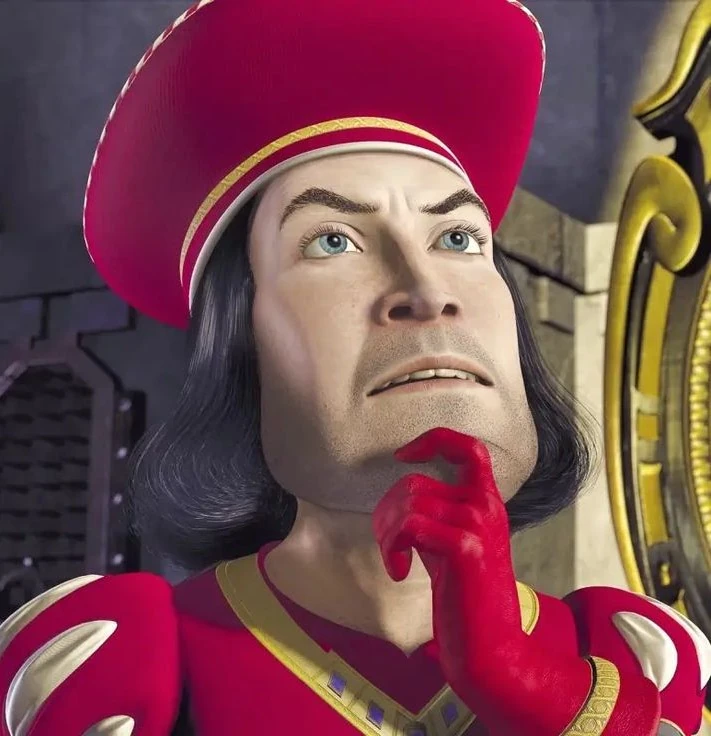
Image source: DreamWorks Wiki - Fandom
How John Lithgow Created a Deliciously Arrogant Villain
John Lithgow’s performance as Lord Farquaad is a masterclass in voice acting. Despite only having approximately 8 to 9 minutes of total screen time in the original film, the character’s presence is felt throughout. Lithgow brought a "delicious arrogance" to the role, balancing genuine menace with comedic insecurity. According to IMDb, his delivery of lines like "Some of you may die, but it's a sacrifice I am willing to make" has become a staple of internet culture.
The "Muffin Man" interrogation scene is perhaps the character's most famous moment. It parodies the tropes of a high-stakes police thriller using the language of nursery rhymes. Lithgow’s ability to switch from a whisper to a theatrical shout makes the scene both hilarious and slightly unsettling. The character's physical design, featuring a prominent chin and a bob haircut, was also influenced by historical portraits of Richard III, further leaning into the "tyrant" archetype.
Movie vs. Musical: The Secret Backstory of His Father
While the 2001 film leaves Farquaad’s origins largely a mystery, Shrek the Musical provides a significant expansion of his lore. In the stage version, it is revealed that Farquaad is actually a "Half-Dwarf." His father is none other than Grumpy from Snow White. This revelation adds a tragic layer of irony to his character; his hatred for fairytale creatures is actually a form of self-loathing.
This backstory explains his abandonment issues and his desperate need to prove he is "big" enough to be a King. The musical uses this to humanize him slightly, though he remains a pompous antagonist. The comparison between the two versions highlights how the stage production leaned into the psychological roots of his villainy.
| Feature | Shrek (2001 Movie) | Shrek the Musical |
|---|---|---|
| Species | Human (Short Stature) | Half-Dwarf |
| Father | Unknown | Grumpy (from Snow White) |
| Motivation | Pure Power & Perfection | Power + Abandonment Issues |
| Fate | Eaten by Dragon | Eaten by Dragon (with a song) |
How Do Actors Play a Three-Foot-Tall Man on Stage?
One of the most impressive technical feats in modern theater is the portrayal of Lord Farquaad. Because the character is roughly three feet tall, actors like Christopher Sieber (who originated the role on Broadway) must perform the entire show on their knees. This is achieved through a specialized "Farquaad Rig."
The rig consists of a costume that masks the actor's real lower legs behind a black backdrop or a heavy cape. Small, prosthetic legs are attached to the actor's thighs, which move in sync with their kneeling steps. This creates the visual illusion of a tiny man walking and dancing. However, this performance takes a significant physical toll on the actors.
Technical Performance Tips for Theater Actors
- Kneepad Selection: Community theater actors on Reddit's theater communities suggest avoiding standard volleyball pads. Instead, use hockey goalie pads or professional flooring/roofer pads to handle the impact of the "kick-line" numbers.
- Balance and Center of Gravity: The cape acts as a visual mask, but it also adds weight. Actors must practice finding their center of gravity while kneeling to prevent tipping over during high-energy scenes.
- Physical Stamina: Performing a full musical while restricted to a kneeling position requires immense core strength and knee durability. Actors often undergo specific physical therapy to manage the strain.
The Evolution of the Lord Farquaad Meme Culture
Long after the original film's release, Lord Farquaad found a second life in the surrealist world of internet memes. The most famous of these is the "E" meme, which surfaced around 2018. This "deep-fried" image features a mashup of YouTuber Markiplier’s face onto Lord Farquaad’s head, accompanied by the single letter "E."
The "E" meme represents a shift toward Gen Z humor, where context is stripped away in favor of visual absurdity. Farquaad’s distinct features made him a perfect canvas for this type of surrealism. Additionally, the character has been ironically adopted as a "Short King" icon on platforms like TikTok and Twitter. Users celebrate his confidence and "main character energy," despite his villainous nature.
A surrealist mashup of Markiplier and Farquaad that became a cornerstone of 2018 internet culture.
Modern social media users ironically praise Farquaad as a symbol of short-stature confidence.
The "kneeling rig" remains a popular challenge for cosplayers at conventions worldwide.
Key Takeaways
- Satirical Roots: Farquaad is a parody of corporate ego, specifically targeting the Disney leadership of the late 90s.
- Lore Expansion: While the movie focuses on his quest for power, the musical reveals a deeper "Half-Dwarf" backstory involving Grumpy.
- Voice Mastery: John Lithgow’s performance is widely regarded as one of the strongest voice-acting roles in animation history.
- Technical Ingenuity: The stage version uses a notably innovative "kneeling rig" to maintain the character's iconic height.
- Internet Legacy: His presence in meme culture, particularly the "E" meme, has kept the character relevant for a new generation.
- Thematic Foil: He serves as the perfect antithesis to Shrek, valuing external perfection over internal character.
To truly appreciate the depth of this character, one should watch the original Shrek alongside the Broadway production to see how different mediums handle his unique physical and psychological traits.
Frequently Asked Questions
- How tall is Lord Farquaad?
- While his exact height is never stated in inches, he is estimated to be roughly 3 feet tall. This height is central to his character design and the visual gags throughout the film, emphasizing his "small" stature in contrast to his massive ego.
- Is Lord Farquaad based on a real person?
- Yes, he is widely considered a parody of former Disney CEO Michael Eisner. This was a result of the professional rivalry between Eisner and DreamWorks co-founder Jeffrey Katzenberg. His design also takes inspiration from historical figures like Richard III.
- Who voiced Lord Farquaad in the movies?
- The character was voiced by the acclaimed actor John Lithgow. Lithgow's performance is celebrated for its theatricality and arrogance, which helped make Farquaad one of the most memorable villains in the Shrek franchise.
- What is the "Muffin Man" scene?
- The "Muffin Man" scene is a comedic interrogation where Farquaad tortures the Gingerbread Man for information. It parodies intense thriller movies by using the lyrics of the "Muffin Man" nursery rhyme as a high-stakes dialogue exchange.
- Does Lord Farquaad appear in any sequels?
- Lord Farquaad dies at the end of the first film, so he does not appear as a living character in the sequels. However, he returns as a ghost in the Shrek 4-D attraction and makes brief cameo appearances in flashbacks and during the credits of Shrek 2.