Who Was La Virgen Maria and Why She Remains a Global Icon of Faith
La Virgen Maria, known in English as the Virgin Mary, was a first-century Jewish woman from Nazareth and is the mother of Jesus. She stands as a central figure in Christianity and Islam, representing maternal protection, humility, and spiritual strength. Beyond her biblical role, she is venerated through various regional titles, most notably as the Virgin of Guadalupe in the Americas. She is widely regarded as one of the most influential women in human history, depicted in countless works of art and honored by billions across different cultures.
Understanding the Core Identity and Linguistic Roots of Mary
To understand La Virgen Maria, one must first look at her historical and linguistic origins. Born into a Jewish family in the Roman province of Judea, her original name was the Hebrew Miryām (or the Aramaic Maryām). Over centuries, this name evolved through Greek (María) and Latin translations to become the Spanish María and English Mary. According to historical records and religious texts, she was a woman of humble means, living in the small village of Nazareth in Galilee.
While theology often emphasizes her divinity or celestial status, historical context reveals a "human" Mary who navigated the complexities of 1st-century life. Tradition describes her as a seamstress (costurera), a common and vital occupation for women of her time. This practical detail grounds her in the reality of daily labor, providing a relatable point of connection for many devotees. Her life was marked by the psychological weight of her unique calling, which included the social difficulties of an unexpected pregnancy and the eventual trauma of witnessing her son's execution.
In modern times, she is not merely a historical figure but a global symbol. Whether she is called the Blessed Mother, the Madonna, or Maryam, her identity transcends borders. She serves as a bridge between the human and the divine, often viewed as a compassionate intercessor who understands human suffering. Her role as a protector is especially prominent in Latin American cultures, where she is frequently the primary focus of communal prayer and celebration.
Exploring the Early Life and Cultural Setting of Nazareth
The early years of Mary are not extensively detailed in the canonical Gospels, but tradition and apocryphal texts provide a rich narrative. She is widely believed to be the daughter of Joachim and Anne, a couple who, according to tradition, struggled with infertility before her birth. While there is some debate among scholars regarding her exact birthplace—with Nazareth, Jerusalem, and Sepphoris all being cited as possibilities—Nazareth remains the most commonly accepted location for her upbringing.
Life in 1st-century Galilee was rigorous. As a young Jewish woman, Mary would have been immersed in the religious laws and cultural customs of her people. Her betrothal to Joseph, a carpenter (or tekton), followed the legal standards of the time. This period of her life was defined by "social difficulty," as her pregnancy occurred before the finalization of her marriage rites, a situation that carried significant risk in her community. The Capuchin tradition highlights that she likely experienced a panoply of human emotions, including awe, fear, and profound faith, during this transition.
Her daily existence involved the essential tasks of a rural household: fetching water from the village well, preparing meals, and her traditional work as a seamstress. These mundane activities form the backdrop of her spiritual journey. It was in this quiet, domestic setting that the pivotal event of the Annunciation is said to have occurred, transforming a humble village girl into a figure of cosmic significance.
Significant Biblical Events That Defined the Life of Mary
The narrative of Mary in the New Testament is defined by several key milestones that establish her role in the life of Jesus and the early Church. These events are not only historical markers but also the foundation for much of Christian theology.
- The Annunciation: The Angel Gabriel visits Mary to announce she will conceive the Son of God. Her "Fiat" (consent) is considered a pivotal moment of human cooperation with the divine.
- The Visitation: Mary travels to visit her cousin Elizabeth, who is pregnant with John the Baptist. This event is the source of the Magnificat, one of the most famous hymns of praise.
- The Nativity: The birth of Jesus in Bethlehem, followed by the visit of the shepherds and the Magi.
- The Flight to Egypt: Mary and Joseph flee to protect the infant Jesus from King Herod’s decree.
- The Finding in the Temple: A 12-year-old Jesus is found teaching in Jerusalem, where Mary "kept all these things in her heart."
- The Wedding at Cana: Mary prompts Jesus’s first public miracle, demonstrating her role as an intercessor.
- The Crucifixion: Mary stands at the foot of the cross, witnessing the death of her son.
- Pentecost: Mary is present with the Apostles during the descent of the Holy Spirit, marking the birth of the Church.
Each of these events highlights a different aspect of her character: her courage during the Annunciation, her joy during the Visitation, and her immense fortitude at the Crucifixion. These stories have been analyzed for centuries, providing a "Common Coverage Map" for anyone seeking to understand her biblical importance. Her presence at Pentecost is particularly significant, as it positions her as a foundational member of the early Christian community, providing continuity between the life of Jesus and the mission of the Apostles.
The Four Essential Dogmas of the Catholic Church Regarding Mary
In Catholic theology, four specific teachings, known as dogmas, define the nature and role of Mary. A dogma is a truth revealed by God and officially defined by the Church as necessary for belief. Understanding these is crucial for grasping the official stance on her spiritual status.
- Theotokos (Mother of God): Formally defined at the Council of Ephesus in 431 AD, this dogma asserts that Mary is truly the Mother of God because her son, Jesus, is both fully human and fully divine. This was a significant advancement in early Church theology to combat heresies that tried to separate Jesus's two natures.
- Perpetual Virginity: This is the belief that Mary remained a virgin before, during, and after the birth of Jesus. The term Aeiparthenos (Ever-virgin) was confirmed at the Second Council of Constantinople in 553 AD.
- Immaculate Conception: Often confused with the Virgin Birth of Jesus, this dogma refers to Mary’s own conception. It states that from the first moment of her existence, she was preserved from the stain of original sin. This was officially proclaimed by Pope Pius IX in 1854.
- The Assumption: Proclaimed in 1950, this dogma holds that at the end of her earthly life, Mary was taken up body and soul into heavenly glory. In Orthodox traditions, this is referred to as the Dormition (the "falling asleep") of the Virgin.
These dogmas serve to elevate Mary’s status within the faith, distinguishing her from all other saints. While they are central to Catholic and many Orthodox traditions, they are often points of theological discussion and differing interpretation within Protestant denominations, which typically focus more strictly on the biblical text rather than later ecclesiastical definitions.
Distinguishing the Virgin of Guadalupe from the Biblical Mary
A common point of confusion for many is the relationship between the biblical Mary and the Virgin of Guadalupe. It is important to understand that they are the same individual, but the Virgin of Guadalupe represents a specific "advocation" or apparition that occurred in 1531 on the Hill of Tepeyac in present-day Mexico City.
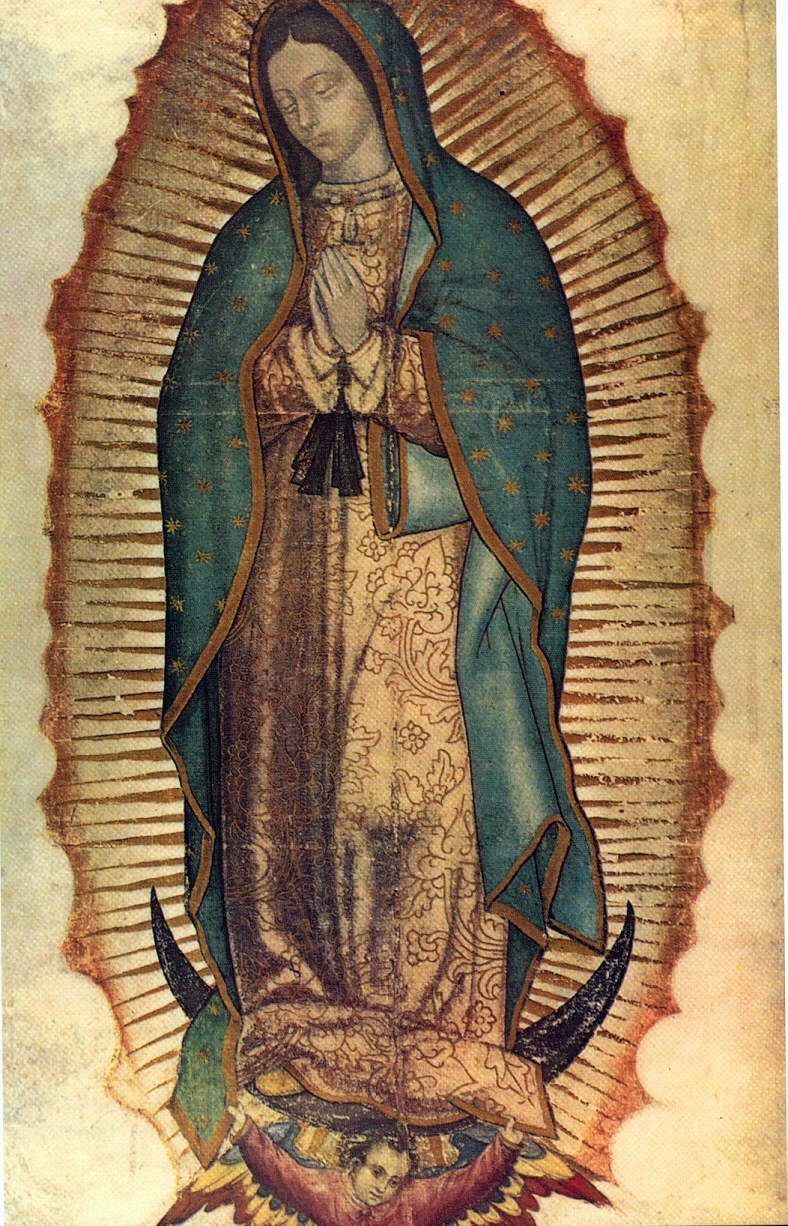
Image source: Wikipedia
The encounter between the Virgin and the indigenous man Juan Diego is a cornerstone of Latin American spirituality. What makes this version of Mary exceptionally strong is the Indigenous Syncretism involved. Research into the Nahuatl language suggests that the name "Guadalupe" may actually be a Spanish transliteration of the Nahuatl word Tequantlaxopeuh, which translates to "she who treads on the stone serpent." To the Spanish ears of the 16th century, this sounded like the name of a famous shrine in Spain, "Guadalupe," leading to the title we use today.
The iconography of the Virgin of Guadalupe is rich with indigenous symbols that were immediately recognizable to the Aztec people. The sun rays behind her, the stars on her mantle, and the black ribbon around her waist (a sign of pregnancy in Aztec culture) all served to communicate her message in a way that bridged two vastly different worlds. Today, the Basilica of Santa María de Guadalupe is the most visited Marian shrine in the world, standing as a testament to her role as the "Patroness of the Americas."
Veneration of Mary in Islam and Other Global Faiths
Mary’s influence extends far beyond the boundaries of Christianity. She holds a position of high honor in Islam, where she is known as Maryam. In fact, she is the only woman mentioned by name in the entire Quran, and an entire chapter (Surah Maryam) is dedicated to her story. Islamic tradition regards her as one of the most righteous and pure women to have ever lived, often cited as a model for all believers.
| Feature | Catholic Perspective | Islamic Perspective |
|---|---|---|
| Virgin Birth | Affirmed as a miraculous sign. | Affirmed as a miracle of Allah. |
| Divinity | Mother of God (Theotokos). | A righteous human prophetess/saint. |
| Titles | Queen of Heaven, Co-Redemptrix. | Sayyidatuna (Our Lady), The Pure One. |
| Mention in Scripture | Frequent in Gospels/Acts. | Mentioned more times than in the NT. |
Beyond Islam, Mary is also respected in the Baháʼí Faith and among the Druze. In these traditions, she is viewed as a spiritual luminary whose life reflects divine attributes. This global veneration makes her a unique figure of interfaith dialogue, representing a shared point of reverence for billions of people across different religious landscapes. Her story of faith and submission to the divine will resonates across cultural and theological divides.
Decoding the Symbols and Colors Found in Marian Iconography
Artistic representations of La Virgen Maria are rarely accidental; they are filled with "Visual Literacy" designed to convey deep theological truths. By understanding the colors and symbols used in icons and paintings, one can "read" the message the artist intended to share.
- Blue Clothing
- Blue is the color of the sky and heaven. It represents Mary’s divinity, her role as Queen of Heaven, and her proximity to God.
- White or Cream
- Symbolizes purity, virginity, and the Immaculate Conception. It is often paired with blue to show the union of her earthly purity and heavenly calling.
- Red Undergarments
- In many traditional icons, Mary wears red beneath her blue mantle. Red represents her humanity and her participation in the Passion of her son.
- The 12-Star Crown
- A reference to the Book of Revelation (12:1), symbolizing her role as the "Woman Clothed with the Sun" and her victory over evil.
- The Crescent Moon
- Often shown at her feet, the moon represents her reflecting the light of Christ, just as the moon reflects the sun. It also symbolizes her dominion over time and change.
- The Lily
- A universal symbol of purity and innocence, frequently appearing in scenes of the Annunciation.
These symbols have remained remarkably consistent over centuries, allowing a devotee from the 12th century to recognize the same themes as a believer in 2026. Whether it is the oldest known icon in Rome, the Madonna del Rosario, or a modern mural in a city street, these visual cues continue to define her image in the public consciousness.
Eight Virtues of Mary That Continue to Inspire Devotion
For many, the appeal of La Virgen Maria lies in her character. She is often presented as a "virtue gap" filler—providing a human model of how to respond to divine intervention. The following eight qualities are frequently cited as the core virtues that believers strive to emulate in their own lives.
1. Humility
Her ability to see herself as a "handmaid" despite her monumental role. She never sought personal glory, always pointing toward her son.
2. Faith
The unwavering trust she placed in the message of the Angel Gabriel, even when the path ahead was unclear and dangerous.
3. Obedience
Her famous "Fiat"—"Let it be done to me according to your word"—is the top-tier example of submission to a higher purpose.
4. Patience
Demonstrated during the long years in Nazareth and the difficult journey to Egypt, showing a quiet strength in the face of adversity.
5. Charity
Her immediate haste to help her cousin Elizabeth upon hearing of her pregnancy, putting the needs of others before her own comfort.
6. Purity
Both physical and spiritual, representing a heart that is undivided and focused entirely on the divine will.
7. Fortitude
The immense courage required to stand at the foot of the cross and endure the suffering of her child without losing hope.
8. Prayerfulness
The Bible notes she "pondered these things in her heart," suggesting a life of deep meditation and constant connection to God.
These virtues are not just theological concepts but practical guides for living. In a modern world often characterized by noise and ego, the Marian virtues of silence, humility, and service offer a significant step forward for those seeking a more contemplative and purposeful life.
Modern Practices and Global Pilgrimage Sites Dedicated to Mary
Devotion to La Virgen Maria is a living tradition that manifests in various ways across the globe. The most common form of Marian prayer is the Rosary, a meditative practice that involves reciting the Hail Mary while reflecting on the "mysteries" of the lives of Jesus and Mary. This practice is a staple of Catholic life, often performed in groups or as a private spiritual exercise.
Feast days also play a major role in the liturgical calendar. Key dates include:
- January 1: Solemnity of Mary, Mother of God.
- September 8: The Nativity of Mary (her birthday).
- December 8: The Immaculate Conception.
- December 12: Our Lady of Guadalupe (a major celebration in the Americas).
Pilgrimage remains one of the most powerful expressions of devotion. Millions of people travel each year to sites where Mary is said to have appeared. While the Basilica in Mexico City is a primary destination, other sites like Lourdes in France and Fatima in Portugal attract massive crowds seeking healing and spiritual renewal. These locations often become centers of immense communal faith, where the "lived experience" of the pilgrims creates a unique atmosphere of hope and solidarity.
Key Takeaways on the Legacy of La Virgen Maria
- Biblical Roots: Mary was a 1st-century Jewish woman from Nazareth, traditionally a seamstress by trade.
- Global Figure: She is highly revered in both Christianity and Islam, where she is the only woman named in the Quran.
- Theological Dogmas: The Catholic Church recognizes four major dogmas: Mother of God, Perpetual Virginity, Immaculate Conception, and the Assumption.
- Cultural Syncretism: The Virgin of Guadalupe is a unique apparition that blended indigenous Nahuatl symbols with Christian faith.
- Visual Literacy: Her iconography uses specific colors (blue, white, red) and symbols (stars, moon, lilies) to convey spiritual meanings.
- Universal Virtues: Qualities like humility, fortitude, and faith serve as a model for billions of people worldwide.
To deepen your understanding, consider visiting a local Marian shrine or exploring the historical texts that detail her life and influence across different cultures.
Frequently Asked Questions About La Virgen Maria
How old was the Virgin Mary when she died?
The Bible is silent regarding the age of Mary at the time of her death or Assumption. However, various traditions suggest she lived into her 50s or 60s. Some historical estimates place her death around 48 AD to 55 AD, assuming she was a teenager at the time of Jesus's birth. Because there is no definitive scriptural record, these figures remain part of pious tradition rather than confirmed historical fact.
Where is the Virgin Mary buried?
There are two primary locations associated with the end of Mary's earthly life: Jerusalem and Ephesus. In Jerusalem, the Tomb of the Virgin Mary in the Garden of Gethsemane is a major pilgrimage site. In Ephesus (modern-day Turkey), the House of the Virgin Mary is also venerated. However, for Catholics and Orthodox Christians, the dogma of the Assumption (or Dormition) teaches that her body was taken into heaven, meaning there are no physical remains to be found in any tomb.
Did Mary have other children besides Jesus?
This is a point of significant theological debate. The Gospels mention the "brothers and sisters" of Jesus. Catholic and Orthodox traditions interpret these as close relatives or cousins, noting that the Greek and Aramaic words for "brother" were often used for extended family. Protestant traditions frequently interpret these passages literally, suggesting Mary and Joseph had other children after the birth of Jesus. The debate often centers on the Greek word heos (until) in Matthew 1:25.
Why is she often shown stepping on a snake?
This imagery comes from a traditional interpretation of Genesis 3:15, where God tells the serpent that the offspring of the woman will crush its head. In Christian iconography, Mary is seen as the "New Eve" who, through her obedience, helps undo the fall of humanity. Stepping on the snake symbolizes her role in the victory over evil and sin through her son, Jesus Christ.
Is the Virgin Mary the same as the Virgin of Regla or Charity?
Yes, these are what are known as "advocations" or titles of the same Virgin Mary. Throughout history, Mary is said to have appeared in different places or has been honored for specific attributes (like "Charity" or "Mercy"). While the titles, clothing, and cultural associations change—such as the Virgin of Regla being associated with the sea—they all refer to the same historical and spiritual figure, the mother of Jesus.